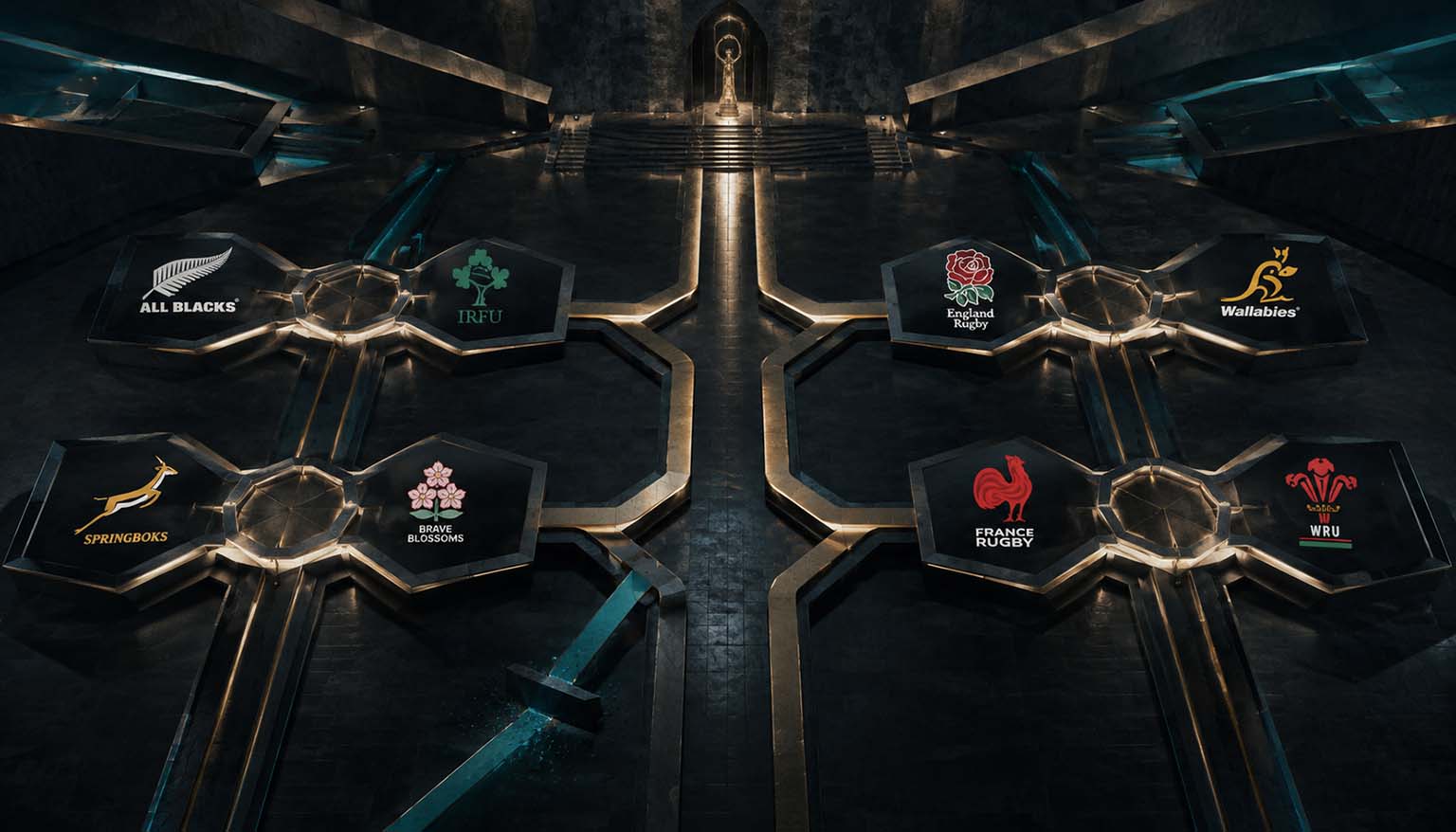

Part of the Rugby World Cup 2019 Case Study
This chapter belongs to The Human Futurist’s RWC 2019 Case Study: a chronological reconstruction of how an emerging analytical idea moved from retrospective pattern recognition into live prospective testing, comparison, error, refinement and retesting. The important discipline is chronology. At this point in the story, the tournament had not yet begun, and none of the later results was known.
Why the first live RWC 2019 test challenged the All Blacks before a ball had been kicked
The Favourite Was the Test
There is a difference between finding an intriguing pattern after an event and allowing that pattern to confront a future result.
The All Blacks made that difference impossible to avoid.
New Zealand arrived in Japan as the winners of the 2011 and 2015 Rugby World Cups. Steve Hansen had been head coach since 2012 and had already led the side through one of the most dominant periods in international rugby. Kieran Read had been part of both World Cup-winning squads and, after succeeding Richie McCaw as captain, would lead New Zealand into his first World Cup as skipper.
For most observers, the obvious question was whether the All Blacks could become the first team to win three consecutive Rugby World Cups. The historical source opened with exactly that tension. Its answer, published before the tournament began, was uncomfortable: a third consecutive title was considered “highly unlikely”.
That matters because the All Blacks were not selected retrospectively as an easy example. They were the benchmark. If an emerging performance model was going to be tested seriously, the strongest team in the field was precisely the kind of case it needed to confront.
Before the Tournament, the Question Was Already Uncomfortable
The source used Hansen’s 2015 sequence as an internal control because 2015 had already produced an extreme outcome: New Zealand won the Rugby World Cup.
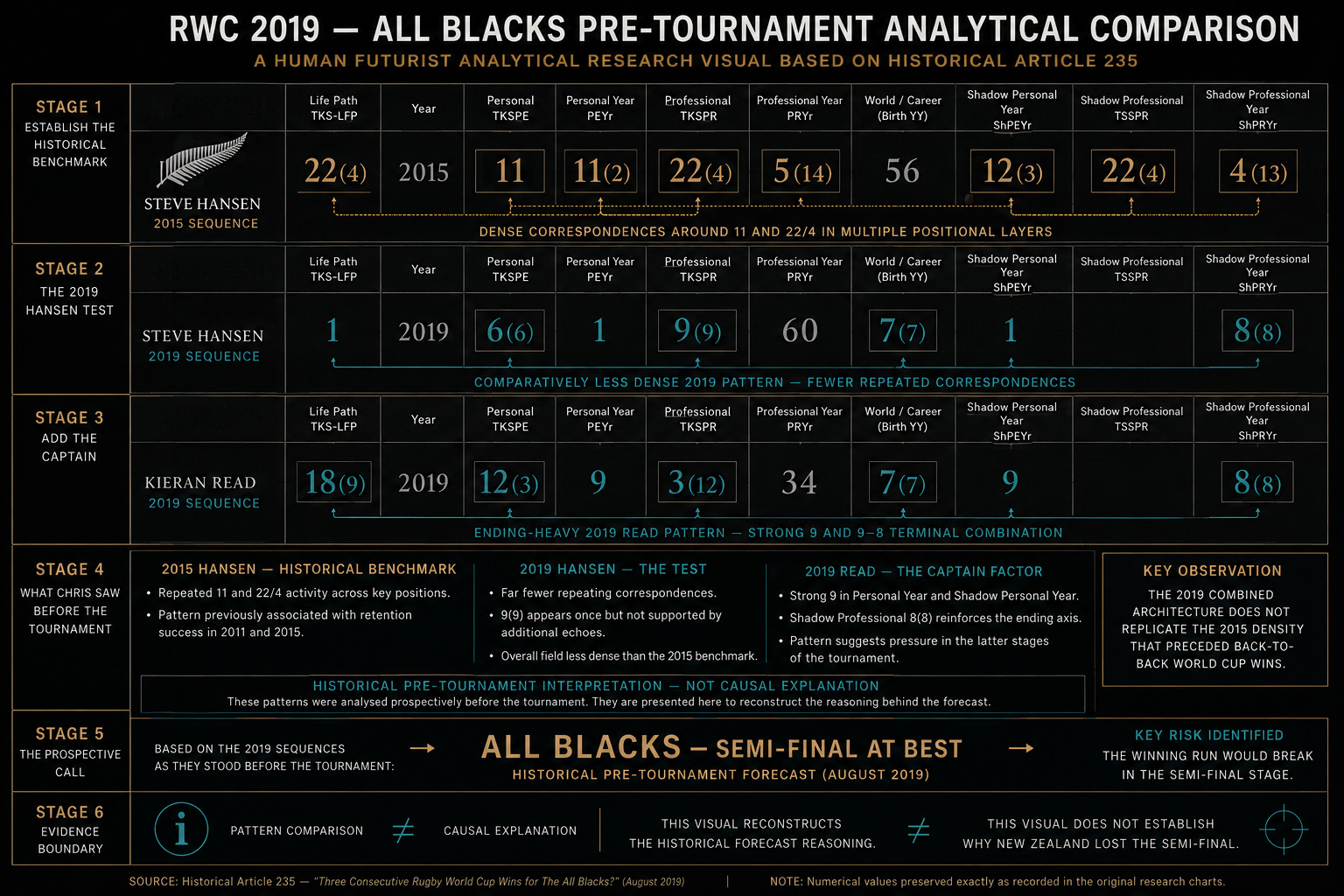
2015 sequence: 22(4) – 2015 – 11 – 11(2) – 22(4) – 5(14) – 56 – 12(3) – 22(4) – 4(13)
The historical interpretation focused on the repetition of 11 and 22/4. Hansen’s Expression Number was 11 and his Professional Attainment Number was 4. The 2015 sequence therefore appeared, inside the model, to contain several correspondences with values already treated as significant in his profile.
The original article described this in highly confident terms and interpreted the 22/4 pattern as consistent with his “team-building efforts” paying off. A contemporary audit has to draw the boundary more carefully. The 2015 correspondence is a retrospective observation. It does not establish why New Zealand won, and by itself it cannot validate a predictive model. What it did provide was a pattern against which 2019 could be compared.
Why Steve Hansen Was Such a Difficult Case to Bet Against
Hansen was not an obvious candidate for a negative forecast. The historical article described him as composed, highly successful and approaching the end of an extraordinary All Blacks coaching era. It cited a win ratio near 89 per cent at the time and emphasised that he had already coached New Zealand to the 2015 title.
That context is important. The research was not arguing that Hansen lacked ability, experience or leadership quality. It was asking something narrower: did the 2019 time-specific pattern contain the same kind of convergence that the emerging model associated with unusually large positive outcomes?
For Hansen, the source identified several baseline values as particularly important: Life Path 9, Emotional Life Path 9, Professional/Career Attainment 4, Personal Number 7 and World/Career Number 6. His full birth name was also calculated to an Expression Number 11, with a Balance Number 5 and a Number 6 Key Life Lesson.
Those values only become meaningful inside the historical method when compared with the annual sequence. That is where the 2015–2019 contrast became the central piece of evidence.
The 2015 Pattern Was the Benchmark
The source used Hansen’s 2015 sequence as an internal control because 2015 had already produced an extreme outcome: New Zealand won the Rugby World Cup.
2015 sequence: 22(4) – 2015 – 11 – 11(2) – 22(4) – 5(14) – 56 – 12(3) – 22(4) – 4(13)
The historical interpretation focused on the repetition of 11 and 22/4. Hansen’s Expression Number was 11, and his Professional Attainment Number was 4. The 2015 sequence therefore appeared, inside the model, to contain several correspondences with values already treated as significant in his profile.
The original article described this in highly confident terms and interpreted the 22/4 pattern as consistent with his “team-building efforts” paying off. A contemporary audit has to draw the boundary more carefully. The 2015 correspondence is a retrospective observation. It does not establish why New Zealand won, and by itself it cannot validate a predictive model. What it did provide was a pattern to compare 2019 against.
Then 2019 Looked Different
2019 sequence: 1 – 2019 – 6(6) – 1 – 9(9) – 60 – 7(7) – 1 – 8(8)
The historical source also noted that the opening 1 was derived from a backing 19, which it interpreted as containing both new-beginning and ending themes.
The important point for the forecast was not that the 2019 sequence contained “bad” numbers. It was that Chris did not see the same density of personally significant values that had appeared in the 2015 success case. In the article’s own language, no sufficiently important number appeared strongly enough in Hansen’s 2019 line to support another extreme-success interpretation.
That absence became evidence inside the model. Not proof. Not causation. A comparative signal.
And it led to the first half of the All Blacks call: Hansen’s 2019 pattern did not look like a third-title year.
Kieran Read Was the Second Half of the Test
The analysis then turned to Kieran Read because the research question was already becoming relational. If Hansen’s profile looked comparatively weak for 2019 but Read’s looked exceptionally strong, could the captain’s pattern offset the coach’s?
For Read, the source identified Life Path 5, Emotional Life Path 13/4, Professional/Career Attainment 4, Personal Number 8 and World/Career Number 5. His full birth name reduced to Expression Number 8, his Balance Number to 3, and the historical system identified 3, 6, 7 and 8 as Key Life Lessons.
Read’s 2019 sequence: 18(9) – 2019 – 12(3) – 9 – 3(12) – 34 – 7(7) – 9 – 8(8)
Again, the source did not see enough positive convergence to classify the year as one of extreme professional success. Particular attention was paid to the repeated 9 values and the final 9–8 combination. The 2019 article interpreted those positions as signalling an ending and a difficult professional-emotional shift.
Today, that interpretive language requires caution. A 9–8 sequence is not independent evidence that a career transition will be negative, and the research cannot establish causation from numerical correspondence. What matters historically is that the interpretation was made before the tournament outcome and contributed directly to the forecast.
Two Leaders. One Team. One Prospective Call.
When Hansen and Read were considered together, the researchers made the decisive move.
They did not conclude that New Zealand were a poor rugby side. They did not claim the All Blacks lacked talent. They did not yet know who New Zealand would face in the knockouts.
They concluded that, within the emerging model, neither the coach nor captain carried the kind of 2019 configuration expected around a championship-level result. Against the strongest conventional candidate in the tournament, Chris was prepared to let the model disagree with reputation.
The historical forecast had three levels:
- Tournament victory: New Zealand would not win Rugby World Cup 2019.
- Possible earlier exit: the article said they “may very well” go home after the quarter-final.
- Final assessment of ceiling: “a semi-final at best”.
Those distinctions matter. “May go out in the quarter-final” was a possibility, not the final success threshold. The clearest frozen forecast was that the All Blacks would not win the tournament and that the semi-final represented their likely maximum progression.
Freeze the Prediction Before Looking at the Result
This is where contemporary case-study discipline becomes more important than the excitement of a successful call.
It would be tempting, knowing what happened next, to rewrite the original article as though Chris had specifically predicted that New Zealand would lose its semi-final. He did not. The article did not name England as the team that would eliminate the All Blacks, and it entertained a quarter-final exit as a real possibility.
The claim that can legitimately be tested is therefore narrower: New Zealand would not win the World Cup, and a semi-final was the upper-bound assessment.
Anything more precise would be hindsight contamination.
Then the Tournament Happened
New Zealand progressed through the pool stage and reached the quarter-finals. There, they defeated Ireland 46–14. That result immediately ruled out the article’s possible quarter-final-exit scenario.
The All Blacks then faced England in the semi-final. England won 19–7, ending New Zealand’s attempt to secure a third consecutive world title. New Zealand subsequently beat Wales 40–17 in the bronze final and finished third overall.
The tournament outcome therefore landed exactly on the article’s stated upper boundary: semi-final at best. But the route matters as much as the endpoint. The quarter-final scenario did not happen, and the historical article did not specify the eventual semi-final opponent or score.
What the Forecast Got Right, and What It Did Not
A credible predictive audit has to resist the urge to turn a mixed forecast into a cleaner story after the fact.
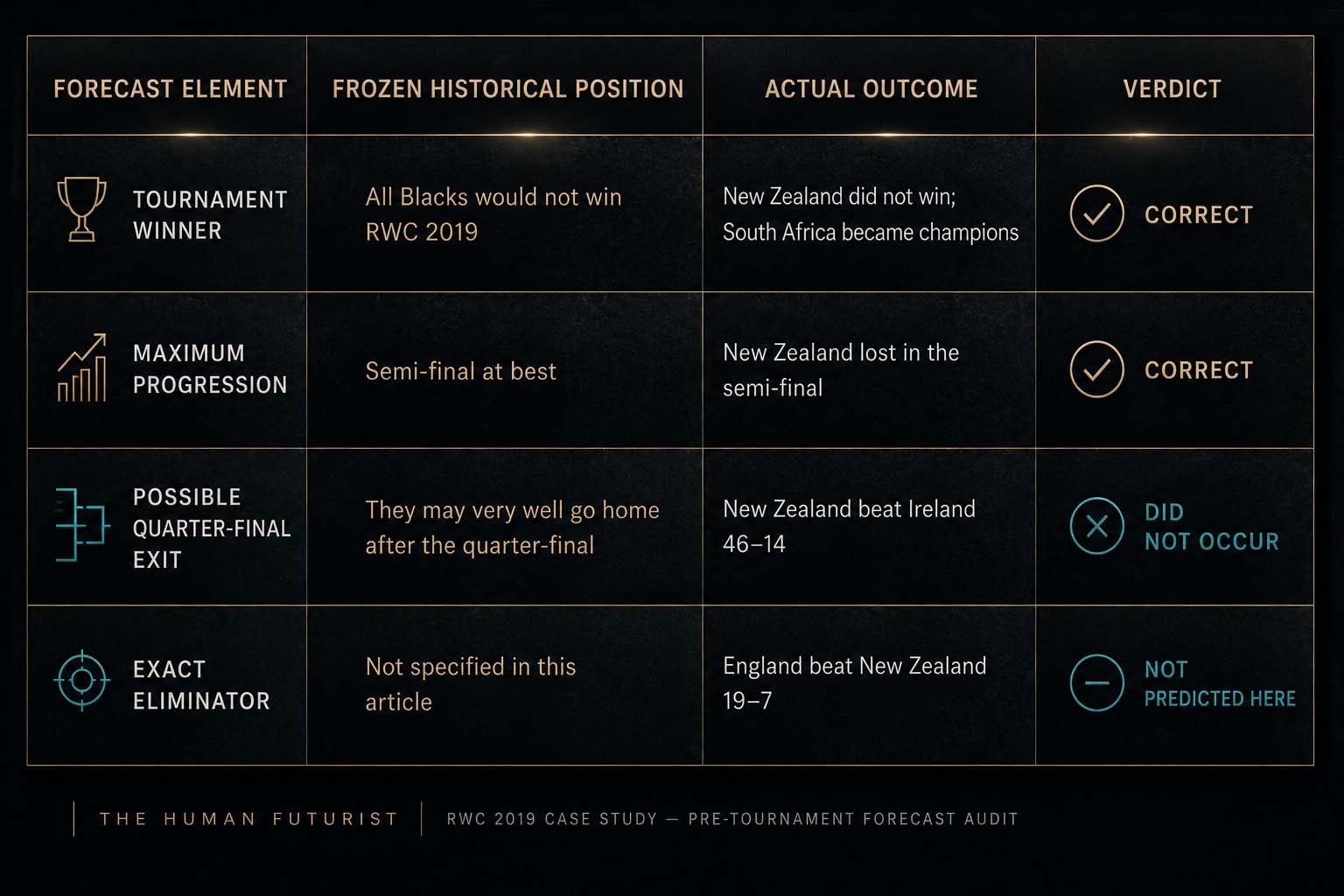
That is a stronger result editorially than claiming a perfect prediction. The evidence does not need exaggeration. The most specific final threshold in the source was met, while one possible route to elimination was wrong.
The More Important Development Was the Method
Seen in isolation, this could be treated as an unusual sporting forecast. Seen inside the RWC 2019 Case Study, it represents something more useful.
The research had moved from retrospective pattern recognition into prospective exposure.
Article 1 asked whether previous Springbok World Cup-winning coaches shared an identifiable architecture around exceptional achievement. This chapter asks what happens when the emerging idea is pointed at the reigning world champions before the next tournament begins.
That is a more demanding question because the future can disagree.
It also introduced an idea that would grow in importance across the tournament: perhaps elite team performance should not be read through one individual alone. Coach and captain occupy different roles, but both influence the competitive system. The RWC 2019 research increasingly treated their relationship as a combined analytical field.
Later chapters would expose that idea to more teams, more explicit match forecasts and, crucially, an incorrect quarter-final prediction. That miss would force a methodological response rather than being removed from the record.
This is why the All Blacks chapter matters. The value is not simply that New Zealand failed to win. The value is that the research crossed a boundary: from noticing patterns in outcomes already known to accepting the risk of being wrong about an outcome still ahead.
What This Article Adds to the Case Study
This chapter is the first major prospective stress test in the RWC 2019 sequence. It establishes three things that the later case study depends upon:
- The model was willing to challenge the strongest conventional favourite rather than only support an obvious winner.
- The coach-and-captain pairing became a meaningful unit of comparison, not merely two separate profiles.
- The forecast can be frozen and audited at different levels of specificity: winner, stage ceiling, possible route and exact match outcome are not the same claim.
The next question becomes unavoidable: if the All Blacks looked weaker than their reputation suggested, which other contenders looked stronger — and could those comparative calls survive the tournament as it unfolded?
Share This Article, Choose Your Platform!
Related Posts





From understanding decisions to informing them.
Beyond the Research
The Business & Leadership archive examines consequential decisions after they have happened.
The Intelligent Mathematical Blueprint and Private Advisory take the underlying Human Futurist thinking into a different environment: helping leaders examine the circumstances surrounding decisions that have yet to be made.