
Part of the Rugby World Cup 2019 Case Study
This is the starting point of a wider Human Futurist investigation into Rugby World Cup 2019.
The later chapters move into live tournament analysis, multiple-team comparison, prospective forecasts, an incorrect prediction, model refinement and further testing.
But none of that makes sense without first understanding the question that came before the predictions:
Was there something structurally distinctive about the people who had already coached South Africa to Rugby World Cup victory?
The Pattern Before the Prediction
Kitch Christie and Jake White were South Africa’s first two Springbok World Cup winning coaches. Before analysing RWC 2019, Chris Styles asked whether their winning years shared an identifiable analytical pattern.
Before You Predict the Future, Look at the Past
By the time Rugby World Cup 2019 arrived, South Africa had twice lifted the Webb Ellis Cup.
The first came in 1995. Kitch Christie was head coach. The second came twelve years later in 2007. Jake White was head coach.
It would have been easy to treat those victories simply as two celebrated moments in Springbok history.
Chris Styles looked at them differently.
Before asking who might win in 2019, he wanted to know whether the two previous South African winning coaches had anything in common within the analytical framework he had been developing.
- Not whether they had similar personalities.
- Not whether they coached in the same way.
- Not whether rugby history could be reduced to mathematics.
The narrower question was more interesting:
Did the analytical structures associated with their World Cup-winning years contain a repeatable relationship worth investigating?
That distinction matters, because this article sits before the predictive phase of the RWC 2019 research.
This was pattern discovery. The test had not started yet.
Two Coaches. Two Eras. Two Very Different Leadership Stories.
Kitch Christie’s 1995 Springboks occupy a unique place in South African sporting history.
The source material describes a coach who remained unbeaten during his Springbok tenure and who thought deeply about what separated exceptional teams from merely talented ones.
Christie spoke about vision. Ability. The need for players to complement one another. What he called “superior discontent”, the constant search for marginal improvement. And discipline.
His description of great teams is particularly revealing because it is not built around individual brilliance alone. His emphasis repeatedly returns to the system: the relationship between ability, purpose, discipline and collective execution.
Francois Pienaar later described the trust between captain and coach in equally direct terms. He listened to Christie. He trusted his advice. He implemented the game plan.
That relationship will become important later in the wider Human Futurist rugby research.
But at this point, Chris was looking at Christie himself.
Then there was Jake White. White’s account of elite coaching presents a rather different world. He describes inheriting staff he may not have selected, managing competing egos, dealing with colleagues who may not believe in his direction and making decisions about players who resist change.
It is a picture of leadership under organisational tension.
- Talent alone is not enough.
- Alignment matters.
- Environment matters.
- Authority matters.
- The people around the coach matter.
And, as White makes clear, the role can be extraordinarily isolating.
These were not two interchangeable leaders. This made the analytical comparison more interesting.
The First Layer: Their Names Did Not Produce the Same Result
The original analysis began with what was then called the 365 Pin Code Full Birth Name Analysis.
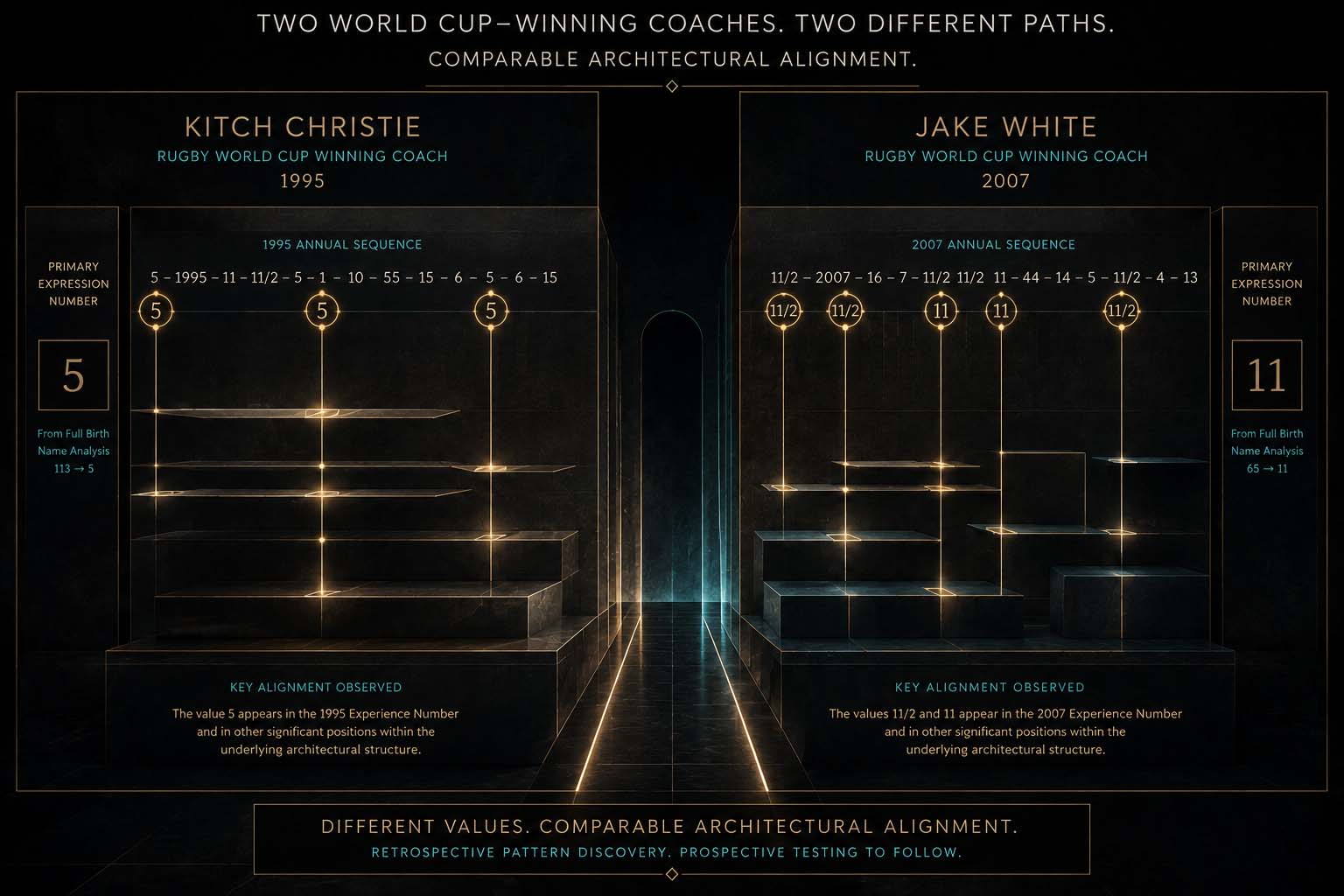
For George Moir Christie, the source records: George = 39, Moir = 28, Christie = 46. Combined: 39 + 28 + 46 = 113. And: 1 + 1 + 3 = 5
The source therefore identifies Christie’s Primary Expression Number as 5.
For Jacobus Westerduin, the source records: Jacobus = 17, Westerduin = 48. Combined: 17 + 48 = 65. And: 6 + 5 = 11
The source identifies White’s Primary Expression Number as 11.
Already, there was an important point. Chris was not looking for two identical men carrying the same central value. They did not. Christie produced 5. White produced 11.
The potential relationship would have to exist somewhere deeper in the architecture.
Christie: When 5 Appeared in More Than One Place
The next stage was to examine Christie’s wider chart.
The original analysis identified the 5 not only as his Primary Expression value, but also elsewhere within the architecture associated with his career and attainment structures.
That became important when Chris moved from the static chart to Christie’s year-by-year sequence.
For 1995, the year South Africa won the Rugby World Cup, the historical model produced the following line:
5 – 1995 – 11 – 11/2 – 5 – 1 – 10 – 55 – 15 – 6 – 5 – 6 – 15
The first value in that line was the significant one for this stage of the research.
Christie’s 1995 Experience Number was 5.
That meant the value associated with the year of his World Cup victory aligned with the 5 already appearing in his Primary Expression structure and elsewhere in the chart.
Chris was not simply seeing a number appear once. He was seeing repetition across different calculated positions. That was the beginning of the proposition.
White: A Different Number, a Similar Relationship
The analysis then moved to Jake White and his 2007 World Cup-winning year.
White’s Primary Expression value was not 5. It was 11.
The source also identifies an 11 within an attainment position in his underlying chart.
Then came the annual sequence. For 2007, the model produced:
11/2 – 2007 – 16 – 7 – 11/2 – 11/2 – 11 – 44 – 14 – 5 – 11/2 – 4 – 13
Again, the opening value was significant. White’s 2007 Experience Number was 11/2.
The same master-number structure identified in his Primary Expression calculation was appearing in the year in which he coached South Africa to the Rugby World Cup title.
The numbers were different from Christie’s. The relationship was not. And that was the part Chris wanted to understand.
The Pattern Was Not “Winning Numbers”
This distinction is critical. Christie did not win because of a 5. White did not win because of an 11.
The historical analysis cannot establish that.
Nor does finding a repeated mathematical relationship explain the vast number of factors that actually determine elite sporting performance: coaching, players, selection, preparation, opposition, tactical decisions, injuries, tournament structure, psychology, execution and circumstance.
The interesting observation was narrower.
In both previous South African World Cup-winning coaching cases, the value associated with the coach’s Primary Expression structure reappeared prominently in the analytical architecture of the championship year.
In Christie’s case, the focal relationship centred on 5. In White’s case, it centred on 11.
Different values. Similar structural behaviour. That is a much more useful proposition than claiming there is a single “World Cup-winning number”.
From Matching Numbers to Analytical Architecture
This is where the earlier examination of South Africa’s World Cup-winning coaching history begins to matter to the wider RWC 2019 Case Study.
Chris was beginning to move beyond asking:
What does this number mean?
towards asking:
What happens when independent parts of a model align around the same event?
That is a significant change.
One isolated value can be interesting. Several independent positions relating to the same value create a different analytical question.
Later Human Futurist research would increasingly describe this kind of phenomenon through ideas such as convergence, alignment and eventually convergence density.
But in the RWC 2019 chronology, this comparison represents an earlier stage. The architecture was beginning to matter more than the individual number.
And because Christie and White represented two separate World Cup victories, the comparison offered something more valuable than a single retrospective case.
There was now a pattern. The next question was whether it could survive exposure to another tournament.
The Difference Between Discovery and Prediction
There is an important evidence boundary here. Chris already knew that Christie had won in 1995. He already knew that White had won in 2007.
This analysis was therefore retrospective.
The outcomes came first. The pattern was identified afterwards.
That means the Christie–White comparison can generate an interesting proposition. It cannot validate that proposition.
This is precisely why the next stage of the RWC 2019 research becomes more consequential.
Once a pattern has been identified from known historical outcomes, there are two choices. You can keep looking backwards and finding further examples. Or you can expose the idea to something that has not happened yet.
Rugby World Cup 2019 created that opportunity.
Then the Question Changed
By itself, the Christie–White comparison might have remained an intriguing historical observation.
But the timing mattered. This analysis was being undertaken in the context of another Rugby World Cup.
South Africa had another head coach. Rassie Erasmus. Another captain. Siya Kolisi.
And another tournament whose result was still unknown.
The research question could therefore move. It was no longer simply:
What did South Africa’s previous World Cup-winning coaches have in common?
It became:
If this relationship mattered enough to notice historically, would anything comparable appear around the people leading South Africa in 2019?
That is the threshold between the foundation and the experiment. And it is the threshold this Case Study now crosses.
Why This Foundation Matters
Without this chapter, the later Rugby World Cup predictions can look like isolated calls. They were not.
The archive shows a developmental sequence.
- First came the historical comparison.
- Then the emerging proposition.
- Then the attempt to apply it prospectively.
- After that came broader tournament forecasts.
- Then an incorrect prediction.
- Then refinement.
- Then further testing.
The importance of Christie and White is therefore not that two historical victories somehow “proved” the model.
It is that their comparison gave Chris something specific enough to investigate next.
A relationship had become visible. Now it had to face the future.
What This Article Adds to the Case Study
This chapter establishes the historical foundation of the RWC 2019 investigation.
It identifies the first coach-level pattern behind the later research: in South Africa’s previous World Cup-winning cases, the winning year contained a notable alignment between the coach’s annual Experience value and important positions already present in his analytical architecture.
It also establishes the evidential boundary that will govern the rest of the Case Study.
This was retrospective pattern discovery, not prospective proof.
That distinction is essential. Because the next chapter changes the knowledge state. The tournament outcome is no longer known.
The model is about to be exposed to 2019.
Share This Article, Choose Your Platform!
Related Posts





From understanding decisions to informing them.
Beyond the Research
The Business & Leadership archive examines consequential decisions after they have happened.
The Intelligent Mathematical Blueprint and Private Advisory take the underlying Human Futurist thinking into a different environment: helping leaders examine the circumstances surrounding decisions that have yet to be made.