
Part of the Rugby World Cup 2019 Case Study
This Case Study follows a research question as it moved from retrospective patterns into live tournament forecasts, team-by-team comparisons and outcomes that had not yet happened. By the time Chris turned to Japan, the tournament itself had already supplied new information: the hosts had beaten Russia, Ireland and Samoa and were one match away from a landmark that Japanese rugby had never reached.
The historical analysis was made during the pool stage, after the Samoa match and before Japan faced Scotland. That timing matters. Japan’s later 28–21 win, first quarter-final and eventual defeat by South Africa belong to the retrospective part of the story, not to the evidence available when the call was made.
The Coach and Captain Behind Japan’s Breakthrough
One match from history
The question was simple enough to fit in a headline: would Japan make their first-ever Rugby World Cup quarter-final?
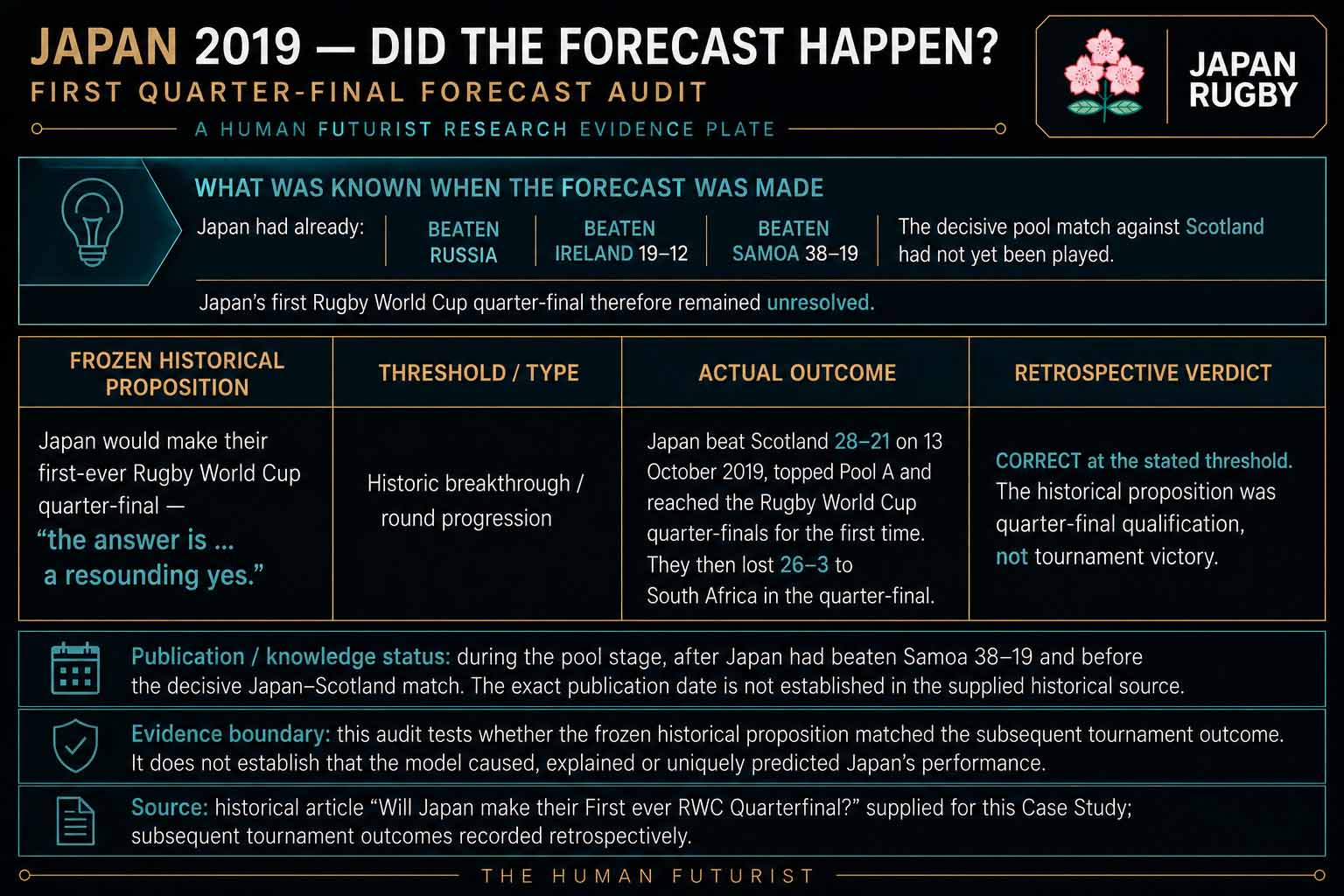
The situation behind it was anything but simple. The host nation had opened by beating Russia, then stunned Ireland 19–12 and followed that with a 38–19 bonus-point victory over Samoa. Japan were in control of their route, but Scotland still stood between them and the knockout stage.
For Jamie Joseph, the expectation surrounding the team had changed almost overnight. Japan were no longer being treated as an entertaining outsider. They had created the possibility of something unprecedented, and now had to carry the pressure of finishing it.
That made this chapter different from a broad prediction about who might win the World Cup. The success threshold was narrow and visible: qualify for the quarter-final. Nothing more had to be added to make the proposition testable.
Why 2015 still mattered
Japan had already learned how cruel the pool stage could be. In 2015 they produced the famous 34–32 victory over South Africa and won three matches, yet still failed to reach the last eight. They became the first team in Rugby World Cup history to win three pool matches and miss the quarter-finals.
Four years later, the memory sharpened the question. A strong tournament was not the same thing as a breakthrough. Beating Ireland was not the threshold. Three pool wins were not the threshold. The quarter-final itself was the threshold.
Chris therefore returned to the same coach-and-captain lens that had been used elsewhere in the 2019 research programme. The focus was Jamie Joseph and Michael Leitch: did their 2019 patterns reinforce the idea that Japan were positioned for an exceptional professional year at precisely the point when history was available to be made?
What Chris saw in Jamie Joseph
The historical source records Joseph’s 2019 line as:
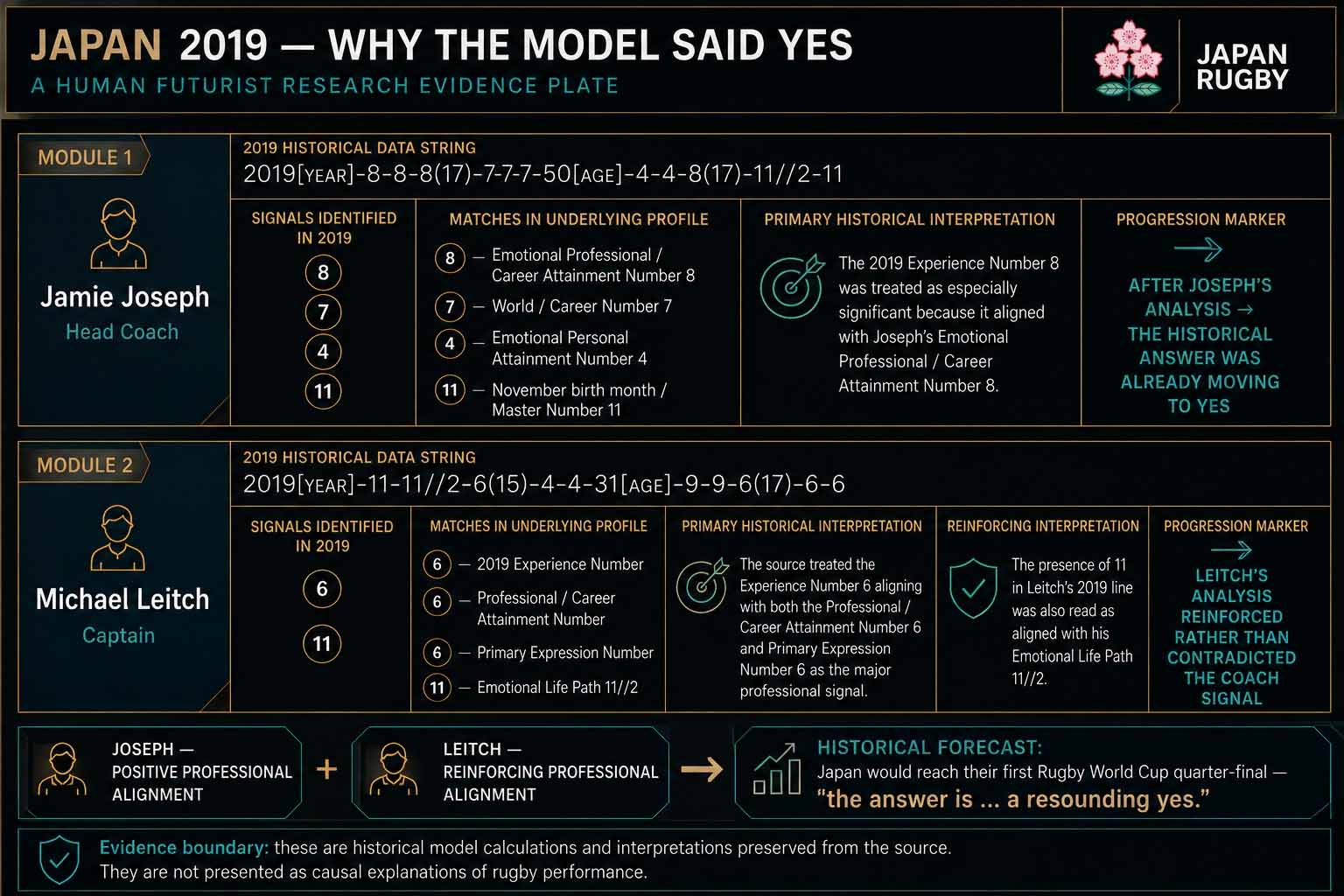
2019[YEAR]-8-8-8(17)-7-7-50[AGE]-4-4-8(17)-11//2-11
Chris’s interpretation centred on four values recurring through the line, 8, 7, 4 and 11 — and on the fact that each also appeared in positions he considered significant in Joseph’s underlying profile. In the source, 8 was especially important: Joseph’s 2019 Experience Number was read as 8, matching his Emotional Professional / Career Attainment Number.
The source described the year as “red-hot” for Joseph and treated the pattern as strongly success-oriented. In contemporary Human Futurist language, the important point is not the superlative. It is the structure of the reasoning: before the Scotland result was known, the coach’s 2019 line was being interpreted as unusually aligned with his established career-related positions.
On Joseph alone, Chris had already moved toward yes. But the captain still had to be tested.
The captain strengthened the signal
Michael Leitch’s 2019 line was recorded as:
2019[YEAR]-11-11//2-6(15)-4-4-31[AGE]-9-9-6(17)-6-6
Here the historical interpretation focused particularly on 6. Leitch’s 2019 Experience Number was read as 6, while 6 also appeared as his Professional / Career Attainment Number and as the Primary Expression Number calculated from his full birth name. The source also highlighted 11 because it aligned with his Emotional Life Path position.
Chris treated the overlap between Leitch’s Experience and Expression values as a significant professional signal. More importantly for the Japan question, the captain did not weaken what had appeared in the coach’s analysis. The two readings pointed in the same broad direction: 2019 looked unusually consequential for both men professionally.
That convergence mattered because the forecast was not being built from Japan’s results alone. By then, anyone could see that the Brave Blossoms were playing well. The additional question was whether the historical model, applied before qualification was secured, independently supported the possibility of the breakthrough.
The forecast was unusually clear
After analysing Joseph and Leitch, the historical article did not hedge its central proposition. It asked again whether Japan would make their first Rugby World Cup quarter-final and answered: “a resounding yes.”
That wording should be preserved exactly for what it was — and no more. It was a forecast of historic round progression. It was not a forecast that Japan would win the World Cup, reach the semi-final or beat a named quarter-final opponent.
This precision is one of the reasons the Japan chapter is useful in the wider Case Study. The threshold was defined before the result and could be audited without moving the goalposts afterwards.
What happened next
On 13 October 2019, Japan beat Scotland 28–21 in Yokohama. The victory completed an unbeaten pool campaign, put Japan top of Pool A and took the Brave Blossoms into the Rugby World Cup quarter-finals for the first time.
The breakthrough forecast was therefore correct at the threshold actually stated.
Japan’s tournament then continued for one more match. On 20 October, South Africa beat them 26–3 in the quarter-final. That later defeat does not reduce the earlier forecast, because winning the quarter-final was never the proposition being tested here. Equally, reaching the last eight should not be inflated into a stronger claim than the source made.
What the result does and does not establish
Retrospectively, this is one of the cleaner tests in the RWC 2019 portfolio. The question was specific, the answer was explicit and the subsequent event matched it.
But a correct forecast does not tell us why Japan won. It does not establish that the model caused performance, explain tactics, measure coaching quality or replace conventional rugby analysis. Japan’s preparation, skill, cohesion, home support and match execution remain part of the real sporting explanation.
What the case does preserve is something narrower: a documented analytical proposition was made while the outcome was still unresolved, and the stated threshold was subsequently met. That makes it useful evidence when the wider research programme is judged as a portfolio rather than through a single celebrated result.
Why this chapter matters beyond Japan
Forecasting becomes easier to overstate when the target is vague. “A good tournament”, “strong performance” or “one to watch” can be made to fit almost anything after the event. Japan offered the opposite.
There was a line that either would or would not be crossed. The Brave Blossoms had never reached a Rugby World Cup quarter-final. Before the decisive pool match, Chris said they would.
That does not settle the validity of the wider methodology. It does, however, show why clearly defined thresholds matter. Precision makes a forecast more exposed to failure, and therefore more informative when it is audited later.
What this article adds to the Case Study
Japan adds a clean historic-breakthrough test to the RWC 2019 sequence. Unlike forecasts about tournament winners or later-stage matchups, the proposition had one clearly bounded endpoint: first-ever quarter-final qualification. The coach and captain analyses pointed in the same broad direction, the forecast was stated before the decisive Scotland result, and the threshold was subsequently met.
Share This Article, Choose Your Platform!
Related Posts





From understanding decisions to informing them.
Beyond the Research
The Business & Leadership archive examines consequential decisions after they have happened.
The Intelligent Mathematical Blueprint and Private Advisory take the underlying Human Futurist thinking into a different environment: helping leaders examine the circumstances surrounding decisions that have yet to be made.