Part of the Rugby World Cup 2019 Case Study
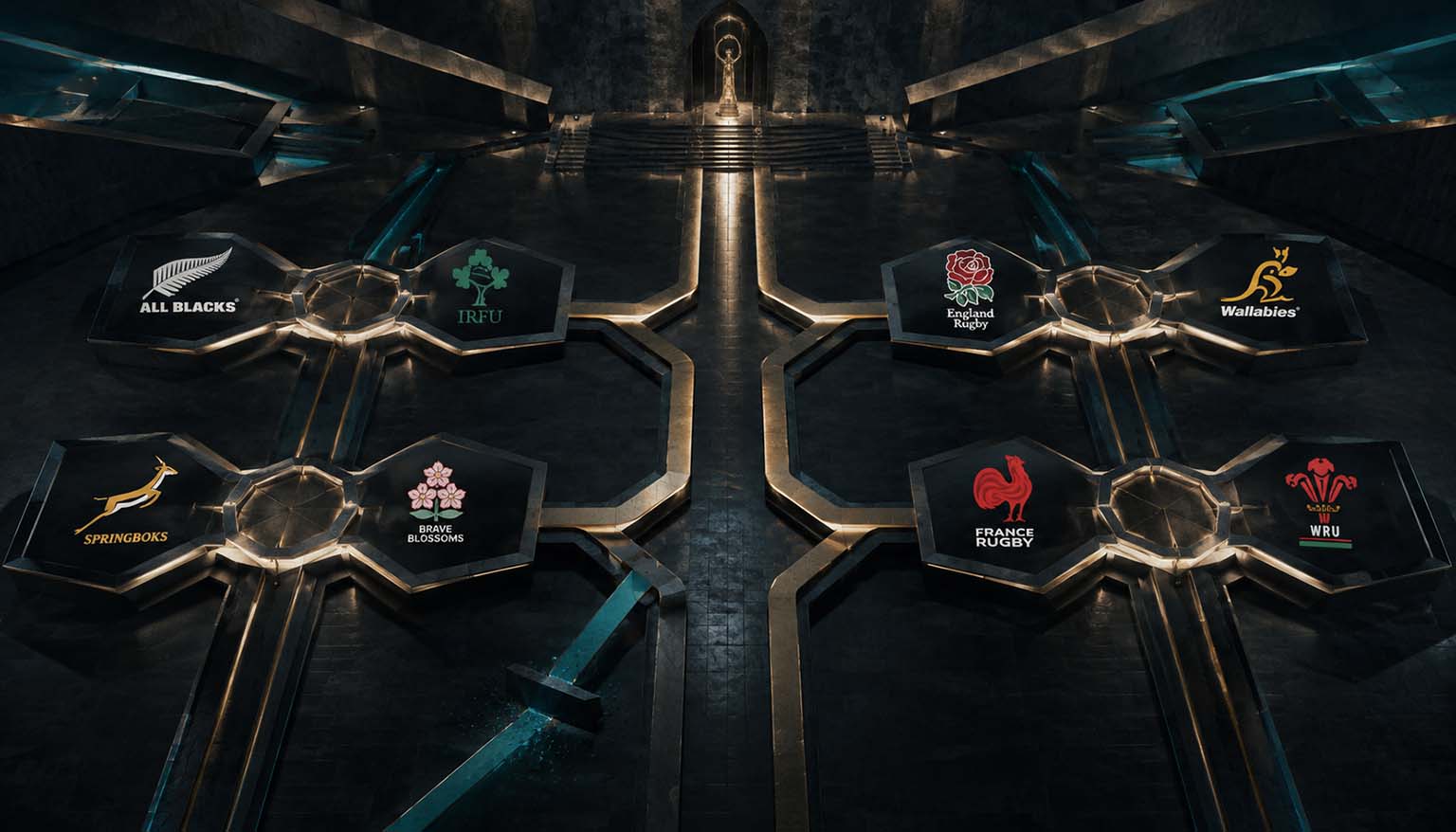
This Case Study follows a research question as it moved from retrospective pattern recognition into live tournament testing across multiple teams. By this point, Chris had already compared several leading nations and had seen that coach and captain did not always point in the same direction.
The Springbok source was written while the tournament was still alive and before South Africa’s semi-final against Wales and any possible final had been decided. That timing is essential. The later victories over Wales and England belong to the retrospective audit; they cannot be allowed to make the original forecast sound more certain, cleaner or more inevitable than it was.
RASSIE, SIYA AND THE SIGNALS OF 2019
One team was gathering momentum
By the time the 2019 Rugby World Cup reached its decisive phase, South Africa no longer looked like a side merely recovering from difficult years. Under Rassie Erasmus, the Springboks had won the Rugby Championship and were becoming increasingly cohesive as the tournament progressed.
There was also history behind the question. South Africa had won the World Cup in 1995 under Kitch Christie and again in 2007 under Jake White. Earlier in the Human Futurist research sequence, those two winning coaches had been examined for recurring patterns around exceptional achievement. The live 2019 question was more demanding: did anything comparable appear around the leadership pair trying to win the trophy now?
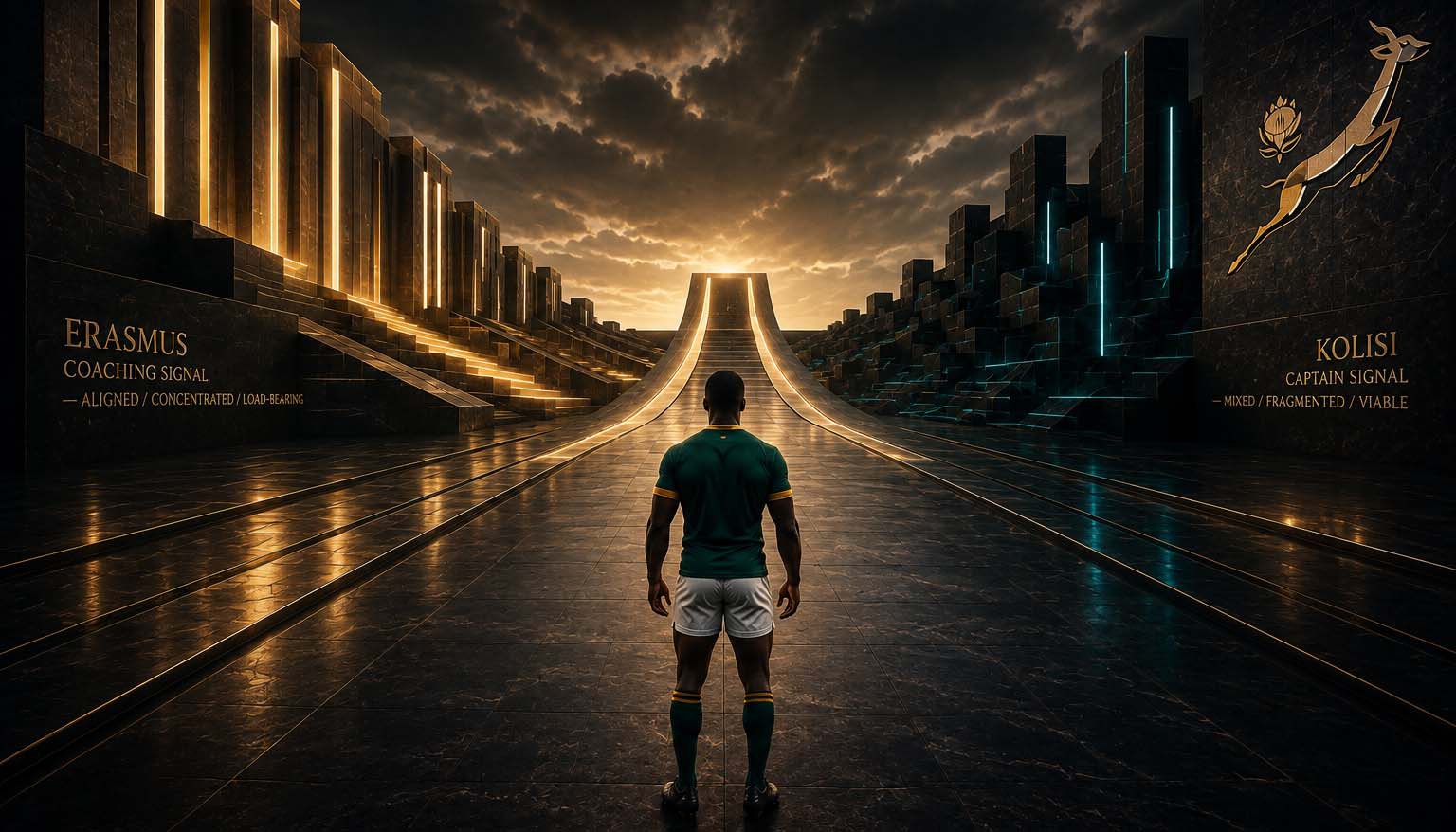
The historical article placed Erasmus and captain Siya Kolisi side by side. What made the comparison interesting was that they did not produce a neat, symmetrical answer.
Why Rassie changed the comparison
Erasmus was the standout case in the source. His 2019 line was recorded as:
2019[YEAR]-10-1-7(7)-5(5)-47[AGE]-9-9-7(7)-6-6.
Chris focused particularly on the repeated 7 and 6 values.
The central historical observation was the 7. Erasmus’s Personal Attainment Number was also 7, and his 2019 Experience Number was 7. The source treated that overlap as a concentrated attainment-year signal. It also noted that his Professional/Career Attainment Number was 6 and that 6 appeared again in the 2019 line.
In the language of the original article, this made Erasmus’s year look exceptionally strong. More importantly for the Case Study, the claim was comparative: after analysing the coaches of Australia, New Zealand, Ireland, Wales and England, Chris wrote that no other coach’s 2019 profile came close to Erasmus’s.
That was the point at which South Africa became more than one contender among several. The research had found a coach whose 2019 pattern appeared materially stronger than the field.
The captain did not give the same answer
Siya Kolisi made the picture less tidy and therefore more useful. His 2019 line was recorded as:
2019[YEAR]-7-7-8(17)-8-8-28[AGE]-12-3-8(17)-3-12
The source highlighted his 17//8 Experience Number, the repeated 8s and the appearance of 7 as his Personal Year, linking that 7 to his Personal Number.
But Chris did not describe Kolisi’s overall pattern as equivalent to Erasmus’s. He called it a “mixed bag”. Several of the captain’s principal baseline values did not repeat in the way the historical framework was looking for. The strongest positive interpretation sat around the 8: Kolisi’s 2019 Experience Number matched the source’s Subconscious Self value of 8.
The distinction matters. The eventual South African victory makes it tempting to reconstruct the leadership pair as two equally powerful signals. That is not what the source said. Erasmus looked exceptional. Kolisi looked reasonable to good, with one potentially significant alignment. The historical conclusion came from weighing those unequal signals together, not pretending they were identical.
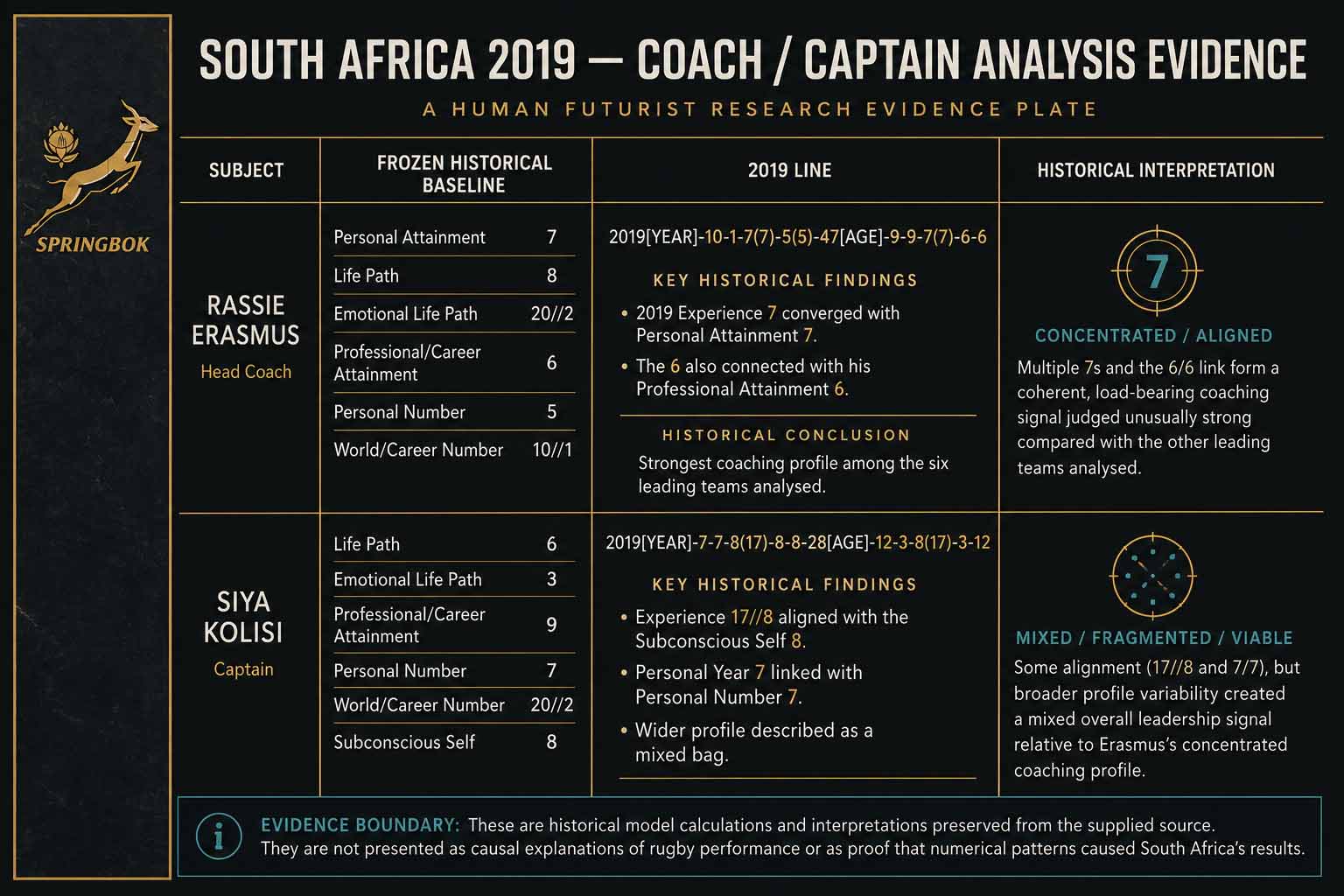
Research Evidence Plate: Rassie Erasmus and Siya Kolisi: the unequal leadership signals preserved from the historical source.
The forecast became more specific
The source did not stop at saying South Africa looked strong. It moved into a set of propositions that can now be frozen and tested separately.
First, the Springboks were forecast to reach the final. Second, the source gave South Africa the edge over Wales in the semi-final. Third, it repeated a South Africa–England final pairing that Chris said had been anticipated from the point the numbers were first run. Fourth, it gave South Africa the edge over England in that projected final and explicitly said Erasmus could take the Boks “all the way to winning the final”.
There was also a broader conditional proposition: whoever won the South Africa–Wales semi-final would go on to lift the Webb Ellis Cup. And the article remained firm that New Zealand would not be the champion.
Those are different thresholds: finalist, semi-final match, final pairing, final match, conditional champion and non-winner. They should not be collapsed into one retrospective claim that “South Africa were predicted to win”. The detail is what makes the historical record auditable.
What happened next
South Africa beat Wales 19–16 in the semi-final. England, having defeated New Zealand 19–7, emerged from the other side of the draw. The final pairing was therefore South Africa against England, exactly as the source had projected.
In the final, South Africa won 32–12 and became Rugby World Cup champions for the third time. Each of the six Springbok-related propositions preserved in the audit above matched the tournament outcome at the threshold actually stated.
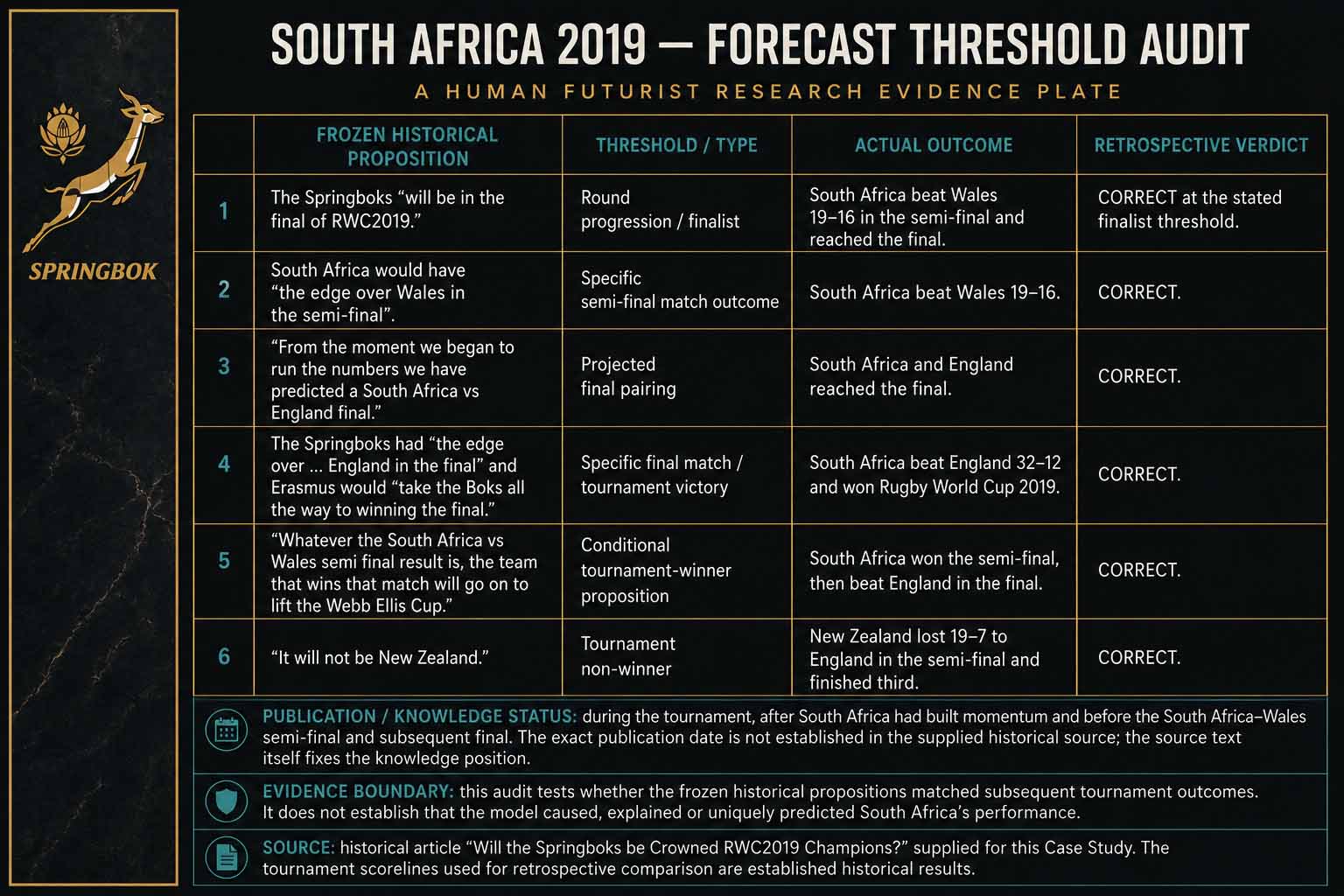
Research Evidence Plate: The six Springbok-related historical propositions audited against the subsequent tournament outcomes.
That is a strong historical result. It should be recorded plainly. It should also be kept in proportion.
Why the result is not the whole story
A successful forecast does not explain why a rugby team won. Erasmus’s coaching, Kolisi’s leadership, selection, preparation, tactics, conditioning, squad depth, opposition performance and the dynamics of knockout rugby all belong to the real-world sporting story. The historical numerical model is not evidence that those mechanisms were caused by a pattern in the data.
Nor should this chapter be detached from the rest of the Case Study and presented as proof by itself. The wider RWC 2019 research contains correct calls, incorrect calls, conditional propositions and routes that did not happen. Its credibility depends on keeping that full portfolio visible.
What makes the Springbok chapter particularly important is therefore not simply that the eventual champion was favoured. It is that the research had reached a point where it was comparing leadership signals across the field, recognising that coach and captain could carry different strengths, and then allowing those observations to generate increasingly specific future claims.
That is a more demanding standard than finding a pattern after the trophy has been lifted. It exposes the method to consequence.
What this article adds to the Case Study
The Springbok chapter brings the comparative country work to its strongest positive coaching case. Erasmus stood apart from the other coaches analysed, while Kolisi prevented the leadership picture from becoming artificially neat. The source then converted that uneven combination into a finalist forecast, a semi-final call, a projected final pairing and a champion call before those outcomes were known.
For the wider Case Study, the chapter raises the next question. A single successful team analysis can be striking; a forecasting framework has to survive a portfolio. The next stages therefore matter because the tournament would soon allow the country-by-country work to be tested match by match — including calls that did not survive contact with the knockout results.
Share This Article, Choose Your Platform!
Related Posts




From understanding decisions to informing them.
Beyond the Research
The Business & Leadership archive examines consequential decisions after they have happened.
The Intelligent Mathematical Blueprint and Private Advisory take the underlying Human Futurist thinking into a different environment: helping leaders examine the circumstances surrounding decisions that have yet to be made.