
Part of the Rugby World Cup 2019 Case Study
This Case Study follows a research question as it moved from retrospective pattern recognition into live prospective exposure during the Rugby World Cup 2019.
By 27 September, the tournament was already under way. Wales had beaten Georgia in their opening match, but their decisive pool encounter with Australia had not yet taken place. Nor was their route through the knockout stages known.
That distinction matters. Everything that follows in the historical analysis must be read from that point in time, before the Australia result, before the quarter-final and before Wales eventually met South Africa.
Wales arrived in Japan with reasons for confidence.
When the Leadership Signals Did Not Agree
They were the reigning Six Nations champions. Warren Gatland was approaching the end of an extraordinary tenure as head coach. Alun-Wyn Jones had been named the outstanding player of the 2019 Six Nations and had become one of the defining leaders of his generation.
From the outside, this looked like one of the most experienced coach-and-captain combinations in international rugby.
Inside Chris Styles’s analysis, however, the picture was considerably less tidy.
Gatland and Jones did not present the same kind of 2019 pattern.
And that created a much more interesting forecasting problem.
Gatland Created the Doubt
The historical analysis first examined Warren Gatland’s longer-term profile and then isolated his 2019 sequence.
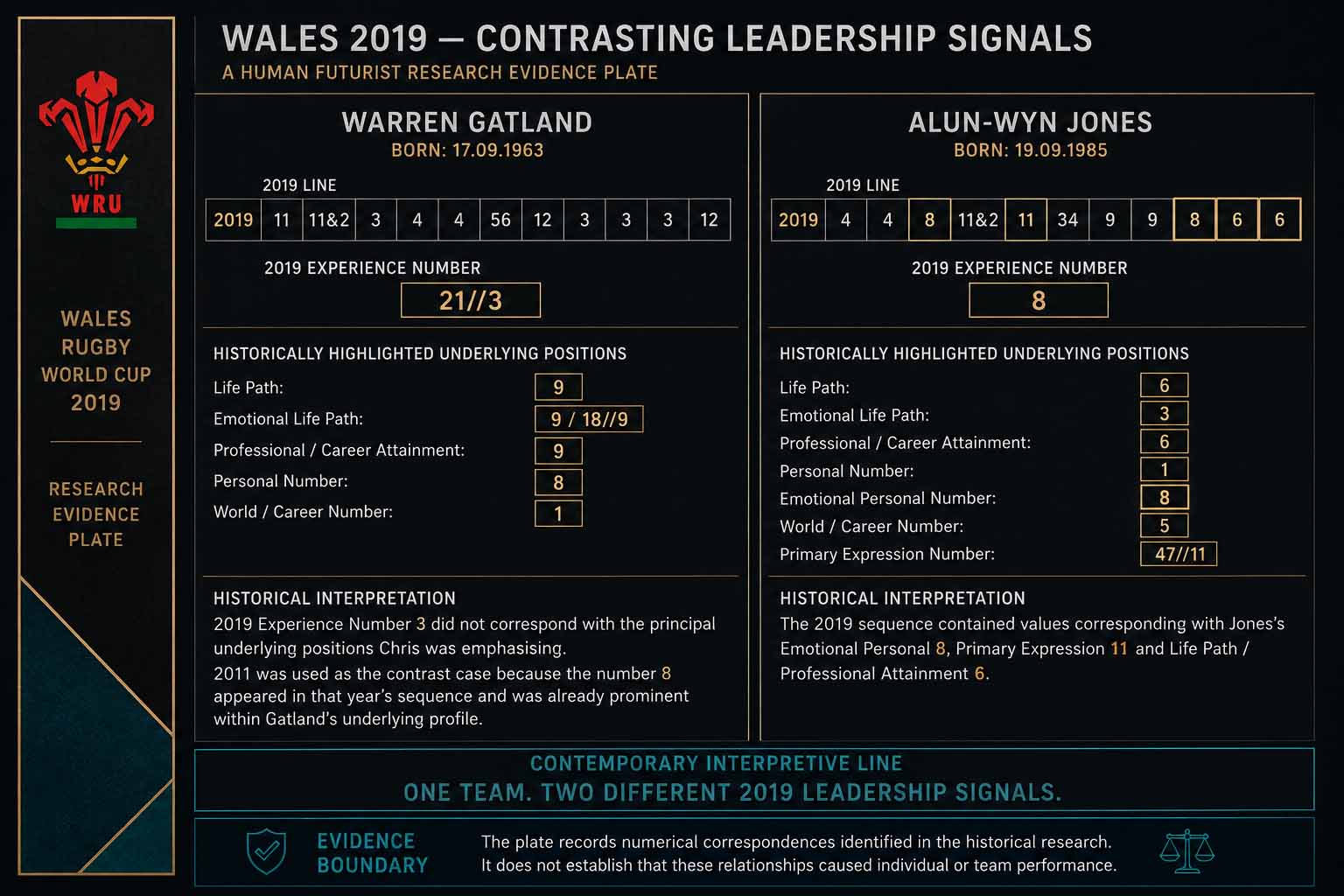
The source recorded his 2019 line as:
2019 — 11 / 11&2 — 3 — 4 — 56 — 12 / 3 — 3 — 3 — 12
His 2019 Experience Number calculated as 21//3.
The significant issue for Chris was not that the number 3 was inherently weak. It was that, within the framework he was using at the time, the 3 did not connect strongly with the principal positions he had identified in Gatland’s underlying profile.
That contrasted with 2011.
When Gatland had taken Wales to the Rugby World Cup semi-final eight years earlier, the historical analysis identified the number 8 within that year’s sequence and noted that 8 already occupied significant positions in his underlying chart.
For 2019, Chris could not see the same kind of connection. That did not lead him to conclude that Wales would fail.
It did something more useful. It introduced uncertainty.
The historical article said that although Chris could see Gatland and Jones taking Wales through to a semi-final against South Africa, Gatland’s 2019 pattern was “not strong at all” in terms of the framework being applied.
That raised a specific question: Could the captain materially change the picture?
Then Alun-Wyn Jones Changed the Comparison
Jones’s 2019 sequence produced almost the opposite reaction.
The historical line was:
2019 — 4 — 8 — 11&2 — 11 — 34 — 9 — 9 — 8 — 6 — 6
His 2019 Experience Number calculated as 8.
This time, Chris saw several connections with positions already present in Jones’s underlying profile.
The 8 connected with his Emotional Personal number.
The Master Number 11 in the annual sequence corresponded with both Alun-Wyn, calculated as 29//11, and his full-name Primary Expression Number of 47//11.
The 6 also corresponded with his Life Path and Professional Attainment positions.
The historical interpretation was emphatic. Chris described Jones’s 2019 line as aligned and convergent and ultimately called it “RED-RED-HOT.”
The language belonged to the original research period. In contemporary Human Futurist terms, the more important observation is narrower:
Several independently calculated positions in Jones’s 2019 sequence corresponded with values already prominent elsewhere in his profile.
That was the pattern Chris regarded as significant. And it was materially stronger than the one he could see around Gatland.
One Team. Two Very Different Signals.
This was what made Wales different from a simple strong-versus-weak comparison.
Gatland was not an unsuccessful coach with an unconvincing record. He was one of the most accomplished coaches Wales had ever had.
Jones was not an isolated individual operating outside that system. He was the captain inside it.
The analytical problem was therefore structural.
If coach and captain were being treated as a combined leadership system, what should happen when one appeared comparatively weak for the year while the other appeared exceptionally strong?
The historical article asked this directly: Could Jones’s numbers offset those of Gatland?
It could not answer that question with certainty. But it did not retreat from making prospective calls.
The First Threshold Was Australia
The immediate test was Wales against Australia on 29 September. The source did not hedge this proposition.
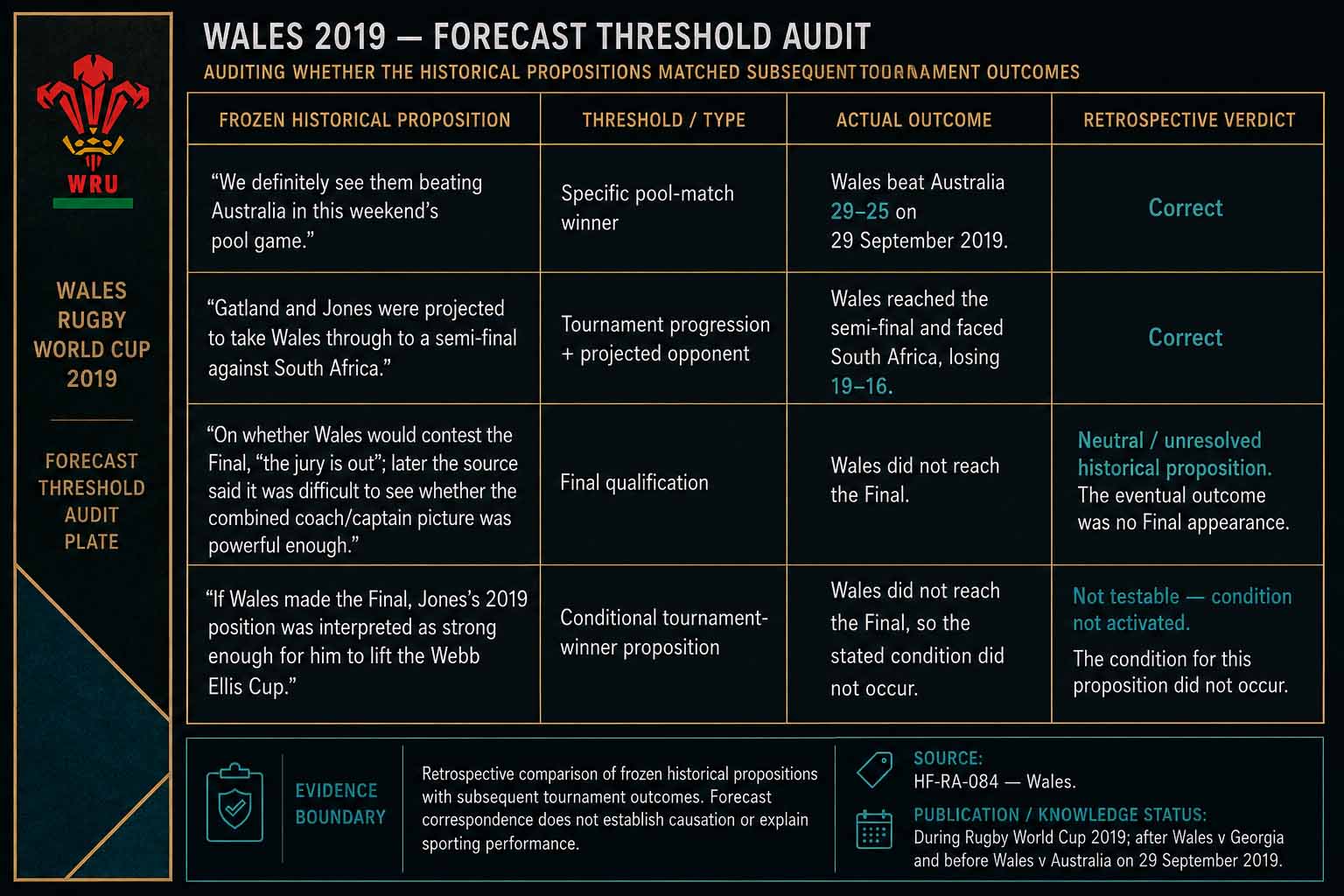
It stated: “We definitely see them beating Australia in this weekend’s pool game.”
This matters because it is a clean historical threshold. It was not a general statement that Wales looked competitive. It was not a claim that they might perform well. It was a prospective match call made before the fixture.
Wales subsequently won 29–25. That proposition therefore survived retrospective audit. But the article went further.
Chris Also Projected the Semi-Final Route
The source connected victory over Australia with what it expected to happen later in the competition.
It described the win as potentially “clearing a path to a mouth-watering Semi-Final against the Springboks.”
Later, when discussing Gatland’s profile, the wording became even clearer: Chris said he could see Gatland and Jones taking Wales through to the semi-final against South Africa.
That was a second, different threshold. Wales first won Pool D, then edged France 20–19 in their quarter-final.
Their semi-final opponent was South Africa. The projected pairing therefore occurred. South Africa won the semi-final 19–16.
The Wales chapter had reached the precise uncertainty that the original analysis had struggled with. They were good enough to get to the semi-final. They were not ultimately good enough to reach the final.
The Final Was Never a Clean Wales Prediction
This distinction needs to be preserved carefully. The headline question of the historical article was:
Will Wales Contest the RWC2019 Final?
But the answer was explicitly uncertain. Early in the source, Chris wrote that “the jury is out.” Later he said he was “battling to see” how the combined Gatland-Jones picture could be powerful enough to take Wales into the final. He nevertheless left open the possibility that Jones’s exceptional individual pattern might prove sufficient.
That is not the same thing as forecasting that Wales would definitely reach the final. The historical position was unresolved. And because Wales lost to South Africa in the semi-final, the final threshold was never crossed.
One More Conditional Claim Needs Separating
The source contained one especially strong sentence: If Wales did make the final, Chris wrote, then given the strength he attributed to Jones’s 2019 pattern, Jones would be the captain lifting the Webb Ellis Cup.
Read carelessly after the event, that could be classified as a failed prediction that Wales would win the World Cup. That would change the historical proposition.
The statement was conditional.
Its premise was: Should Wales make the final… They did not. The condition therefore never became active.
The correct retrospective classification is not testable, rather than simply “incorrect tournament winner”.
This distinction is precisely why forecast thresholds matter.
What Happened to the Wales Forecasts?
Why the Wales Chapter Matters More Than a Correct Scorecard
Wales is valuable to this Case Study precisely because the evidence is untidy. The Australia prediction was correct. The projected semi-final against South Africa was also correct.
But the central final question remained unresolved in the historical article, and the strongest winner statement was conditional on Wales first reaching a final that they never reached.
That mixed structure is more informative than turning the chapter into a simple success or failure.
It reveals a methodological problem that extends well beyond rugby:
How should a forecasting framework behave when several people inside the same system point in different directions?
- A leader does not operate alone.
- A captain does not operate alone.
- A chief executive, chair, founder, board, senior team or political administration does not operate alone either.
If a framework analyses people individually, eventually it has to confront interaction.
The Wales analysis was one of the first places in the RWC 2019 sequence where that problem became impossible to ignore.
The Captain Could Not Simply Cancel Out the Coach
The historical question was whether Jones’s apparently exceptional 2019 configuration might offset the weaker pattern Chris saw around Gatland.
The subsequent outcome does not provide a clean mathematical answer to that question.
- Wales progressed a long way.
- They beat the opponent the research said they would beat.
- They reached the projected semi-final against the projected opponent.
- And then they stopped one match short of the Final.
That outcome is consistent with neither a simplistic “Jones overrode Gatland” interpretation nor a simplistic “Gatland’s weaker signal determined the result”.
There is no evidential basis for either causal conclusion.
Instead, the chapter exposed the limitation of treating individual analytical signals as though they could simply be added together.
The team was a system. And systems create interaction effects that a pair of isolated profiles cannot automatically explain.
That is the deeper contribution of Wales to the research sequence.
What This Article Adds to the Case Study
This chapter completes the early comparison of the leading RWC 2019 teams with Wales, a case where the coach and captain appeared to point in different directions..
It adds four things to the programme:
- a coach/captain combination in which the historical analysis did not point uniformly in one direction;
- a clean pre-match call that Wales would beat Australia;
- a correctly projected progression to a semi-final against South Africa;
- and an unresolved final-level proposition that demonstrates why forecasts must be frozen and audited at their actual stated thresholds.
Most importantly, Wales raises the next methodological question.
Once the individual comparisons had been made, could the research move beyond isolated profiles and begin to understand how the strongest contenders related to one another as the tournament narrowed?
That is where the RWC 2019 programme had to go next.
Share This Article, Choose Your Platform!
Related Posts





From understanding decisions to informing them.
Beyond the Research
The Business & Leadership archive examines consequential decisions after they have happened.
The Intelligent Mathematical Blueprint and Private Advisory take the underlying Human Futurist thinking into a different environment: helping leaders examine the circumstances surrounding decisions that have yet to be made.