Leadership. Judgement. Strategy. Consequence.
Business decisions rarely happen in isolation.
They are made by people operating inside organisations, markets, relationships, pressures, ambitions and changing circumstances.
Some decisions create extraordinary growth.
Others expose weaknesses that were already developing beneath the surface. Some leaders appear to recognise the right moment to act. Others continue with a strategy long after the conditions around them have changed.
The Business & Leadership collection brings together Chris Styles’ research into executives, entrepreneurs, founders, organisations and the decisions that shaped significant periods of success, pressure, transition and consequence.
It asks a deceptively simple question:
What becomes visible when we examine the leader, the decision and the surrounding circumstances together?
Foundational Research brings those studies together.
Business history usually tells us what happened.
A company was founded. A leader took control. A strategy succeeded. A partnership fractured. A business expanded. An executive stepped away. An organisation entered crisis.
But for Chris, the outcome has rarely been the end of the investigation.
It is usually where the investigation begins. What was happening around the leader at the time? What changed? What decisions preceded the outcome? Were similar structures visible during earlier periods? Did significant personal and professional circumstances converge?
Was the eventual result sudden, or had the conditions surrounding it been developing for years?
This collection examines those questions through the lens of decision intelligence, leadership judgement, sequence, recurrence and consequence.
The intention is not to suggest that one factor explains a complex business outcome.
It is to examine whether looking at the human architecture surrounding important decisions can reveal something conventional business commentary may overlook.
Five Leaders. Five Business Questions.
The first five Featured Business & Leadership studies introduce different dimensions of Chris Styles’ research into leadership and organisational life.
A founder building something extraordinary. An executive navigating pressure. A business relationship reaching a turning point. A strategic decision made during a consequential period. A leader whose personal trajectory became closely connected with the organisation they built or controlled.

Each investigation begins somewhere different.
Together, they explore a much larger proposition:
Business performance cannot always be understood by examining the business alone.
Sometimes the person making the decision matters just as much.
Start with the leader. Look at the circumstances.
Follow the sequence. Then consider what the outcome might tell us about judgement, timing and consequence.
Chris Styles’ research into Johnn Sculley
STRATEGIC DECISIONS THAT COMPOUND
Business & Leadership | Patterns of Consequence
John Sculley helped grow Apple dramatically. He also made several decisions whose strategic significance became much clearer years later. Chris Styles’ historical research into Sculley raises a fascinating leadership question: when does an executive decision really end?
The Question
Can a decision that appears rational today quietly remove options that an organisation will desperately need years later?
What Chris Found
Sculley’s Apple story was not one isolated mistake. Chris found a sequence of consequential periods involving leadership conflict, strategic commitments and eventual reversal.
The contemporary research pattern is:
DECISION → LOCK-IN → REDUCED OPTIONALITY → CONSEQUENCE LAG
When collapse and renewal occupy the same moment
South African Airways Institutional Failure and the New Beginning Paradox
A study in collapse, transition and the architecture of renewal.
By 2020, South African Airways had reached a structural breaking point after years of losses, leadership instability and repeated rescue attempts. Yet when Chris Styles examined the organisation’s historical numerical timeline, SAA’s Annual Experience Number for 2020 was 1 — the value the original methodology associated with a new beginning.
The Question
Can an organisational collapse and the beginning of its successor structure be two sides of the same transition?
What Chris Found
SAA’s 2020 Annual Experience Number was 1. The historical research found that AEN 1 intersecting three organisational positions and reported the complete 2020 configuration as unrepeated across SAA’s displayed annual timeline from 1934–2019. At the same time the existing airline was breaking down, government was discussing a fundamentally restructured successor.
From prediction to decision-risk awareness.
Elon Musk Executive Risk and Decision Intelligence
Independence, Emotional Pressure and an Early Numerical Risk-Management Model
Chris Styles examined Elon Musk’s unusual concentration of independence-related Number 1 structures and then looked forward to September. What emerged was more important than another prediction: an early attempt to identify a period of heightened decision risk before the consequence, and use that information to encourage caution.
The Question
Can stable leadership characteristics and time-specific pressure be combined to identify periods when consequential decision-making may require greater caution?
What Chris Found
Musk’s three name components each reduced to Number 1, while his 2018 model contained 11, 22/4 and 19/1 structures in shadow or emotional positions. September then produced a 31/4 Shadow Personal Month against a 22/4 Shadow Personal Year, which Chris interpreted prospectively as an intensified period of constraint and decision risk.
Where extraordinary capacity meets the risk of extraordinary consequence.
THE MASTER BUILDER PARADOX
Markus Jooste helped build Steinhoff into an international corporate empire before its extraordinary crisis.
When Chris Styles examined Jooste’s historical numerical architecture, he found Master Number 22 — The Master Builder, in two central positions, alongside a series of striking capacity, shadow and timing structures.
The Question
Can the architecture associated with exceptional leadership capacity also expose the failure mode capable of creating exceptional organisational risk?
What Chris Found
Jooste’s model contained 22 in both the Person and Life Path, 17/8 in World/Career, 13/4 in Shadow Personal Attainment and an Inclusion Chart in which Number 1 calculated to 210%, while Number 7 was entirely absent. The longitudinal model then brought 13/4 and 8/8 into prominence immediately before the 2017 Steinhoff crisis.
When Success Meets a Concentrated Risk Window
Steve Schwarzman 2022–2025
Personal Attainment, Risk Concentration and the Evolution of Futurist Coaching
Steve Schwarzman entered 2022 after one of the most financially successful years of his career. Yet Chris Styles’ prospective modelling identified several risk indicators converging around the Blackstone co-founder — including the return of his 16//7 Personal Attainment sequence and a recurrence window extending through 2025.
The Question
Can individual temporal modelling identify elevated leadership-risk periods early enough to influence the decisions made inside them?
What Chris Found
The historical model placed Schwarzman’s own 16//7 Personal Attainment sequence back into his Annual Experience architecture in 2022 and then repeated it through 2025, alongside additional 2022 risk concentrations including 13//4 + 16//7 and 9//9.
The Business & Leadership Archive
Research across entrepreneurs, executives, founders, companies and periods of organisational change.
The Featured Research is more selective.
Why These Five?
Within the wider archive, studies are assessed for their research strength, originality, decision-intelligence value, evidence, evergreen value, historical significance and strategic importance.
For this collection, the strongest studies also tend to reveal something meaningful about the relationship between:
the person → the decision → the circumstances → the consequence.
They may identify an unusual period in a founder’s career. Show recurring structures across different stages of organisational growth. Raise questions about executive judgement during periods of risk. Reveal a relationship between personal transition and professional change. Or provide an especially strong example of why leadership cannot always be separated from the person doing the leading.
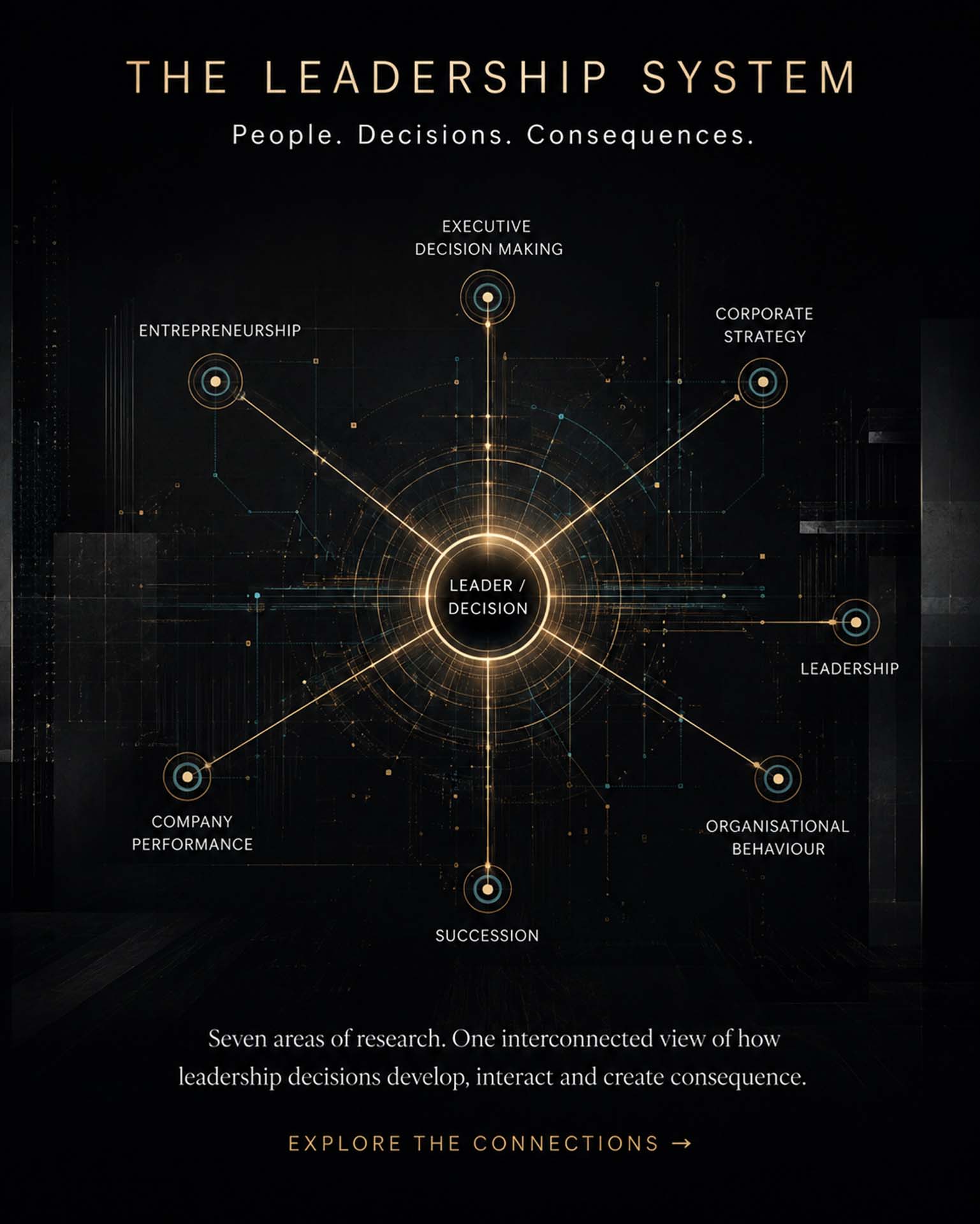
Seven Themes. One Leadership Landscape.
From the individual decision to the organisation around it.
Business & Leadership is organised around seven principal areas of investigation...
They allow individual studies to connect into a broader body of research into how leaders think, act, build, adapt and respond when decisions carry consequence.
Follow the Connections
One Decision Can Reveal a Much Larger Pattern.
The strongest Business & Leadership research often begins with one executive, one organisation or one consequential moment.
Follow those investigations further and they begin connecting leadership with behaviour, performance, innovation, timing and recurring patterns of consequence.
From understanding decisions to informing them.
Beyond the Research
The Business & Leadership archive examines consequential decisions after they have happened.
The Intelligent Mathematical Blueprint and Private Advisory take the underlying Human Futurist thinking into a different environment: helping leaders examine the circumstances surrounding decisions that have yet to be made.