

Breakthrough Under Alignment
Emma Raducanu and the 2021 performance window
Before the US Open final began, the historical model had already identified an unusually concentrated performance opportunity.
Two Months From Wimbledon to a Grand Slam Final
Emma Raducanu arrived at Wimbledon in 2021 ranked far outside the group normally expected to dominate the year’s major championships.
Yet something was beginning to happen.
She reached the fourth round before withdrawing after experiencing breathing difficulties and dizziness. In the historical article, Raducanu described Wimbledon as an overwhelmingly positive learning experience: she had discovered more about her game and, critically, what performing at the highest level required.
Then came New York. Raducanu entered the US Open through qualifying. She kept winning.
- Quarter-final.
- Semi-final.
- Final.
And she had still not lost a set. By the time she defeated Maria Sakkari to reach the championship match, the 18-year-old had become the first qualifier to reach a Grand Slam final.
For Chris Styles, that extraordinary acceleration created a different question.
Was 2021 simply the year in which an exceptional young player broke through?
Or did her developing mathematical model look meaningfully different during the same period?
What Was Chris Looking For?
Article 211 was written using an earlier version of the research that would eventually develop into the Intelligent Mathematical Blueprint.
Its language was still strongly rooted in numerology. The contemporary interest is narrower.
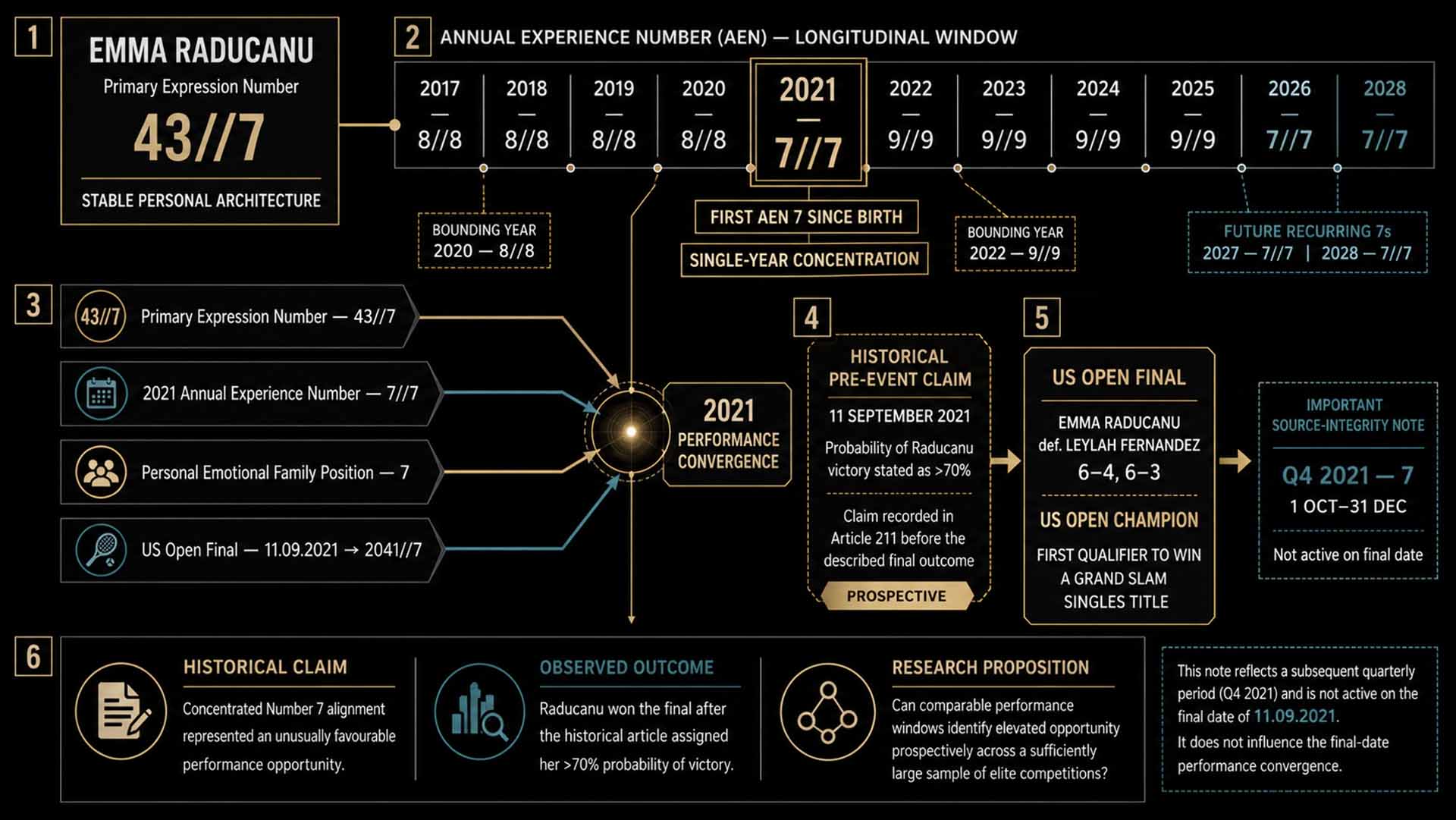
Chris was comparing stable architecture, positions calculated from Raducanu’s date of birth and full birth name, with changing temporal architecture, particularly her Annual Experience Numbers. One stable number stood out in her name analysis.
Her Primary Expression Number was:
43//7
The historical methodology treated the Expression Number as relating to the way an individual’s underlying capabilities find expression. Raducanu’s model also contained 7 in her Personal Emotional Family position.
Neither observation proves anything about tennis performance.
What made the case more interesting was what happened when Chris moved from the person to the year.
Then 2021 Broke the Sequence
Article 211 contains Raducanu’s Annual Experience sequence from birth through 2030.
The surrounding years matter. Her table records:
2017 — 8//8
2018 — 8//8
2019 — 8//8
2020 — 8//8
Then:
2021 — 7//7
Followed by:
2022 — 9//9
2023 — 9//9
2024 — 9//9
2025 — 9//9
2026 — 9//9
The 7 returns later, in 2027 and 2028, which is important because the contemporary archive should not manufacture uniqueness where none exists.
But 2021 was different in a specific way.
According to the historical table, it was the first Annual Experience Number 7 since Raducanu’s birth, and it appeared as a single-year concentration between a long 8//8 sequence and the subsequent 9//9 sequence.
That matters more than simply saying “Number 7 appeared”.
A stable 43//7 Expression Number and a changing 7//7 Annual Experience Number had converged during the year in which her professional trajectory changed dramatically.
Then Chris added another layer.
The US Open women’s final was scheduled for 11 September 2021.
Under the historical calculation:
11 + 9 + 2021 = 2041 → 7
So the championship match itself fell on what the model classified as a 2041//7 day.
Now there were several separately derived 7-related structures surrounding the same event:
43//7 Expression Number
7//7 Annual Experience Number
Personal Emotional Family Number 7
11 September 2021 = 2041//7
This is the evidential moment that makes Article 211 worth revisiting.
Not because convergence proves causation.
Because it happened before the most important outcome was known.
The Forecast Was Made Before the Final
This is where the historical record becomes substantially more important.
The original Archive Analysis described Article 211 cautiously as having identified the final as “fortuitous and positively aligned”.
That is true, but incomplete. The source goes further.
At the end of Article 211, Chris wrote that, given the structures he had identified, there was a: “high probability (as in more than 70%; p=0,7+)” that Raducanu would emerge victorious in the US Open women’s final “later today.”
That wording changes the status of the case. This was no longer merely retrospective interpretation of Raducanu’s extraordinary run.
It was a quantified prospective claim about an event that, according to the internal chronology of the document, had not yet happened.
That does not establish predictive validity. But it gives the case something retrospective success studies cannot possess: An auditable prediction.
There remains an important archival requirement. The surviving document establishes the internal pre-event chronology, but the precise original publication or revision timestamp still needs to be independently recovered before this case should be classified as a fully confirmed prospective audit.
That distinction matters. The research should receive credit for exactly what the surviving evidence supports, no more and no less.
And Then She Won
Later on 11 September 2021, Raducanu faced Leylah Fernandez in the final.
She won 6–4, 6–3.
The victory made Raducanu the first qualifier in the Open Era to win a Grand Slam singles title. She completed three qualifying matches and seven main-draw matches without losing a set.
The extraordinary sporting achievement belongs to Raducanu: her talent, preparation, execution and ability to perform under pressure.
The Human Futurist question is different.
Did the model identify something unusual about the opportunity window before the decisive event occurred?
In this case, apparently yes.
The harder question is whether it can do that again.
One Detail That Has to Be Corrected
Article 211 also demonstrates why historical research should be audited rather than simply republished. The original source introduces another Number 7 structure: Raducanu’s Q4 2021 Pinnacle Number.
It explicitly defines Q4 as running from 1 October to 31 December.
But the US Open final took place on 11 September. The article nevertheless discusses the Q4 Pinnacle while building the argument for the final and describes this additional 7 as part of the “doubling up” surrounding the event.
Temporally, that does not work. The Q4 position had not yet begun.
That component should therefore not be counted as an active convergence on the final date.
Removing it does not erase the prospective prediction. The Expression Number, 2021 AEN, Personal Emotional Family position and 2041//7 final date remain documented in the source.
But excluding the inactive Q4 position matters.
A credible archive must be willing to make the model harder, not easier, to satisfy.
Opportunity Is Not Outcome
There is another important distinction.
Even if future research established that certain concentrations occur disproportionately during exceptional sporting periods, that would not mean the architecture produces victory.
A performance window can only be useful if we distinguish between opportunity and execution.
Two athletes could enter apparently favourable periods and perform differently.
- One may be physically prepared.
- Another injured.
- One may execute brilliantly under pressure.
- Another may encounter an opponent performing at an even higher level.
Coaching, preparation, opposition, conditions, tactical decisions, recovery, psychology and chance remain part of competitive sport.
That makes a more useful Human Futurist proposition possible:
Can mathematical architecture identify periods in which the conditions for exceptional performance appear unusually concentrated, while leaving the actual outcome dependent upon the performer and competitive environment?
That is much more testable than saying that a particular number “makes” someone win.
From One Extraordinary Tournament to a Testable Hypothesis
Article 211 matters because three elements occurred together. There was an objectively extraordinary sporting performance.
There was an unusually concentrated structure within the historical model. And there was a documented probability statement made before the outcome described in the article was known.
- One successful case proves very little by itself.
- A robust test would require many events.
Forecasts would need to be timestamped and locked before competition. The model would need to identify performance windows without knowing later results. Confidence levels would have to be recorded. Favourable windows followed by defeats would count just as much as favourable windows followed by victories. Then the question could finally move beyond Emma Raducanu.
- Do identified Peak Performance Windows outperform chance?
- Do stronger concentrations correspond with higher probabilities of exceptional performance?
- Are some components more informative than others?
- Does the model identify opportunity, even when the performer does not convert it into victory?
- And can high-performance practitioners use that information prospectively, not to predict destiny, but to recognise periods when preparation, recovery, coaching and execution may deserve exceptional attention?
That is where Article 211 becomes more interesting than the successful prediction it contains. Raducanu’s remarkable September 2021 gives the archive a compelling case. The research task now is to find out whether it gives us a repeatable one.
FROM THE HUMAN FUTURIST RESEARCH ARCHIVE
This contemporary article revisits Article 211, produced during Emma Raducanu’s extraordinary 2021 US Open campaign. The historical research examined the relationship between her 43//7 Expression Number, her 2021 Annual Experience Number and other Number 7 structures. Crucially, the source assigned Raducanu a greater-than-70% probability of winning the final before the outcome described in the document had occurred. The original remains preserved within The Human Futurist Research Archive. The case is now reframed as research into Peak Performance Windows, temporal convergence and prospective predictive audit, rather than as proof of numerical causation.
Share This Article, Choose Your Platform!
Related Posts






From understanding decisions to informing them.
Beyond the Research
The Business & Leadership archive examines consequential decisions after they have happened.
The Intelligent Mathematical Blueprint and Private Advisory take the underlying Human Futurist thinking into a different environment: helping leaders examine the circumstances surrounding decisions that have yet to be made.